Its key sentence was hedged the way mathematicians hedge: "I believe I have, working with Claude, discovered a proof of the Riemann Hypothesis." [1] The author, Levent Alpöge, is on the technical staff at Anthropic and a junior fellow at the Harvard Society of Fellows. [2] The note contained no proof in the usual sense. It linked fourteen compressed archive parts holding 175,187 files of Lean 4 code, about 17 million lines in all. [2][3] A conventional write-up, Alpöge said, would have run past 250,000 pages. [2][1]
A day later the Lean FRO and the Mathlib Initiative issued a joint statement: "We have full confidence that Alpöge's proof of the Riemann Hypothesis is correct." [3] No human had read the argument, and no human could have in that time. Yet the verdict carried real weight, because for this one kind of claim a machine can do the refereeing.
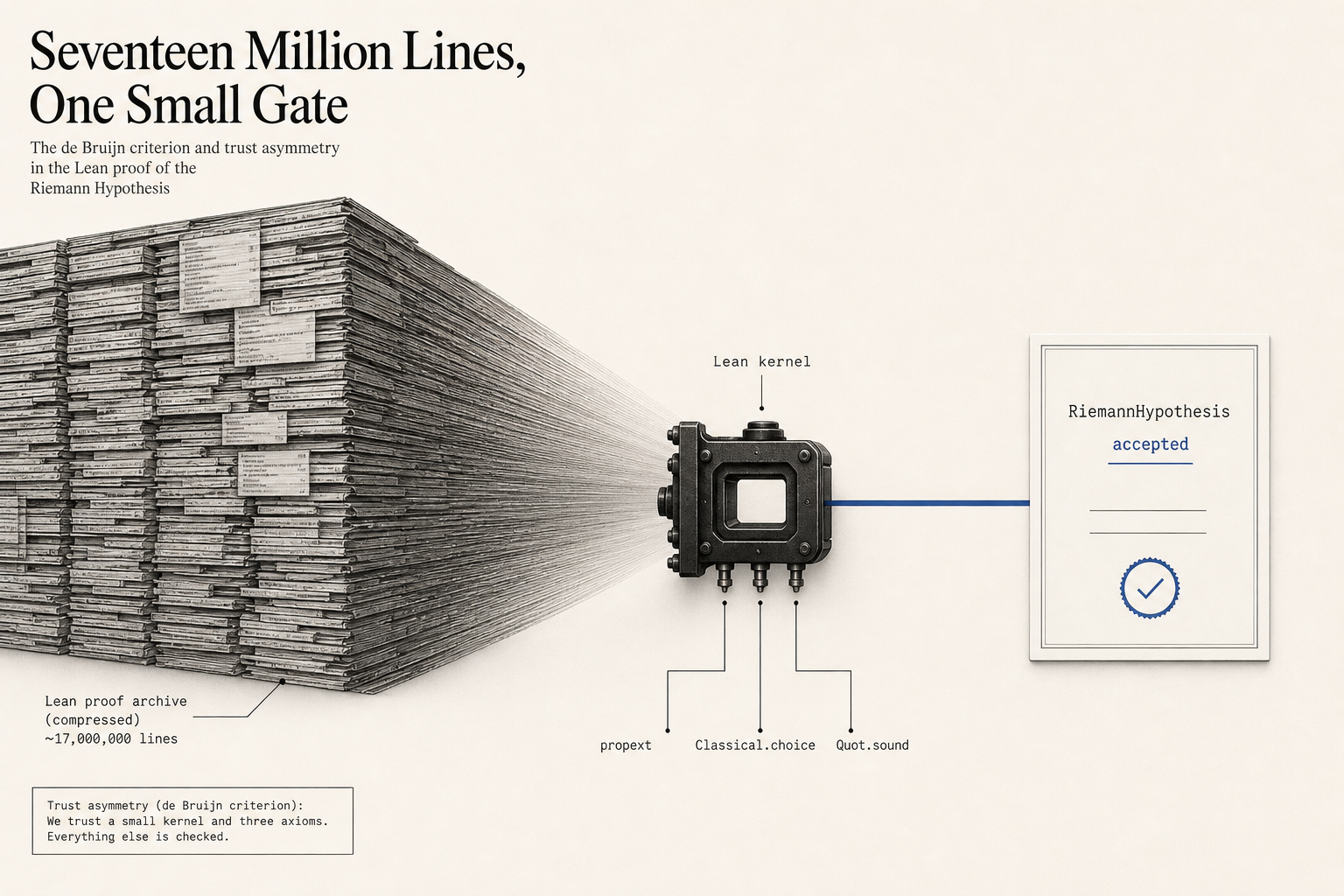
That is the story of mathematics in late 2026. The Riemann Hypothesis episode is the most dramatic example, but it is one of several. In the same months an AI system formalized Fermat's Last Theorem in eleven days, a team produced a Lean formalization of the Poincaré conjecture, and Erdős problems fell and sometimes un-fell. A Navier-Stokes claim arrived on the same day as the Riemann one. Together they show something new: correctness and comprehension have come apart. They also show how far a machine certificate can go and where it stops.
Twenty-four hours in November
The Riemann Hypothesis concerns the prime numbers. Alpöge's note describes it as asking for "optimal control on the count of prime numbers of a given size." [1] Technically, it says that every zero of the Riemann zeta function, other than the trivial zeros at −2, −4, −6 and so on, has real part one half. [4]
The note sketches the method only in outline. It descends from Stepanov's argument for the function-field analogue, in which a divisor "involving multiplicity" does the work. Multiplicity is hard to find over the integers, so the authors chained theta lifts to mimic it. For a von Mangoldt sum of length X, Claude's suggested chain length was √X. [1] Alpöge's own timeline of the work runs from 6 October to 16 November 2026. [1]
He chose not to publish a readable paper. Posting "some massive unreadable travesty of 'slop'" seemed inappropriate to him, so he decided "to only present Lean." [1] He also addressed the timing directly: "There is an obvious cynical view, to do with the timing, but it is false." [1] One outlet reported that the announcement came the day after Anthropic's listing. [5]
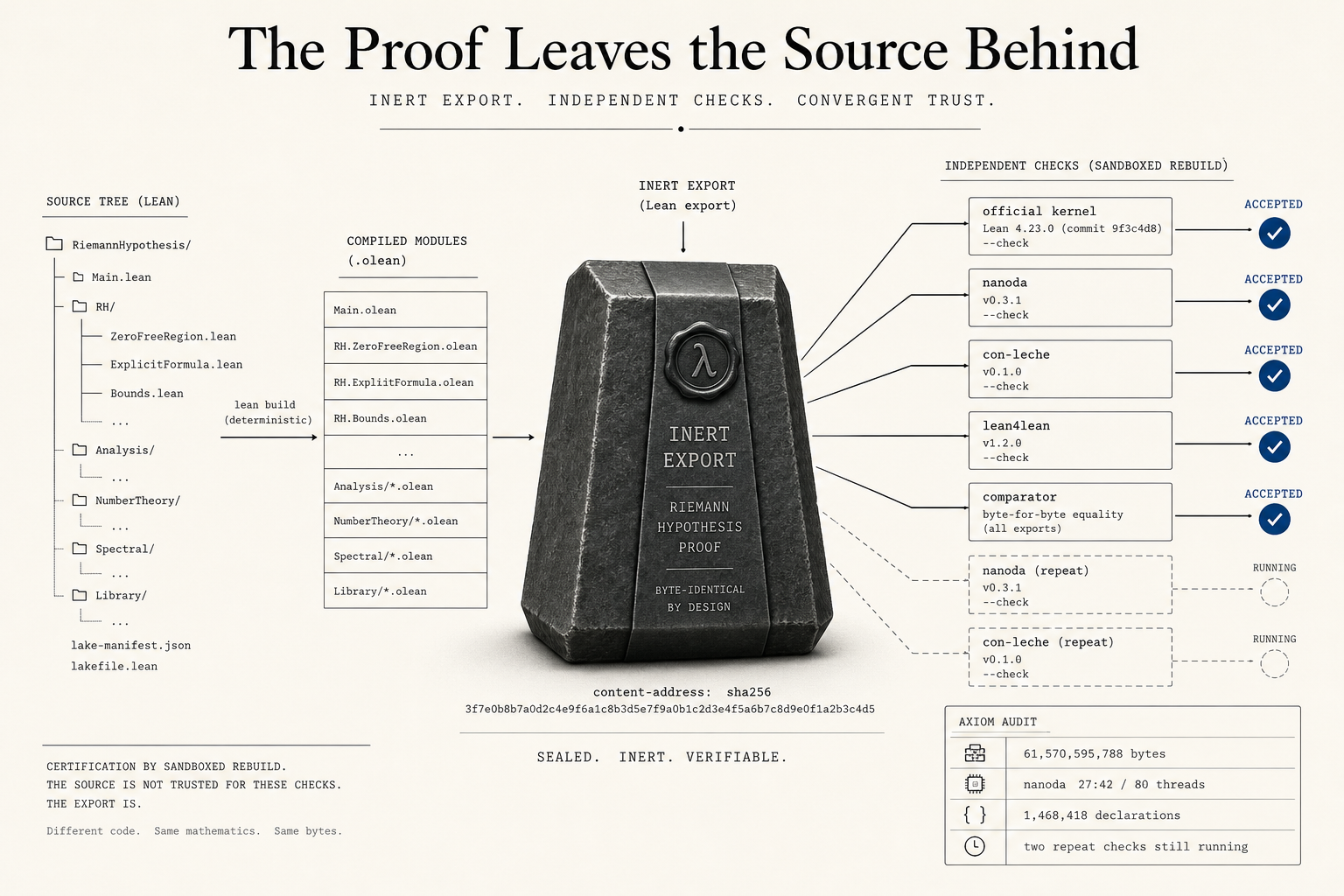
Four tests underlay the Lean community's certification, adapted from a checklist Kevin Buzzard had published on 12 November. First, the statement had to be Mathlib's own definition of the Riemann Hypothesis, which experts in Lean and number theory had already vetted. Second, the library had to compile, and dozens of people reported that it did. Third, the code had to prove that exact statement, which two independent tools, comparator and con-leche --compare, confirmed. Fourth, the proof had to be valid, which several checkers confirmed on an inert export of the proof, out of reach of any hypothetical malicious code in the sources. [3][6]
The most detailed public audit is MIT's Andrew Sutherland. His page, last updated at 16:20 UTC on 22 November, reports the following: [4]
All 175,187 modules compile with zero errors.
The five headline theorems rely on only three axioms: propext, Classical.choice and Quot.sound.
No axioms are declared outside Lean's core.
An independent sandboxed rebuild reproduced the 61,570,595,788-byte export byte for byte.
The independent Rust kernel nanoda accepted the whole export in 27 minutes 42 seconds on 80 threads.
con-leche accepted 1,468,418 declarations.
lean4lean accepted all 175,187 modules, though five hit a default step limit and passed once it was raised.
Sutherland also recorded that the end-to-end run of Lean's official comparator and the official kernel's replay of the export were still running. The official kernel had already accepted every module from the compiled files. [4] The certification was issued while those two repeat checks were unfinished, and the record should say so.
The scope is narrower than the headline. Five theorems were verified: Mathlib's RiemannHypothesis, a restatement of it, and three results for Dirichlet L-functions, including the usual form of the Generalized Riemann Hypothesis for primitive characters. "GRH" here means Dirichlet L-functions only. Dedekind zeta functions, Hecke L-functions and automorphic L-functions in general were not among the statements checked. [4] As a cross-check that does not depend on Mathlib's definition of zeta, the proof was combined with an independent formalization of Robin's and Lagarias's criteria. That yields two statements about the divisor sum, with no hypotheses and no mention of zeta. [4]
What is not settled is large. No human-readable proof exists, and Alpöge says he still has to understand the argument and "write it properly." [7] The Clay Mathematics Institute still lists the Riemann Hypothesis as unsolved. [8] Its rules require publication in a qualifying outlet, a wait of at least two years, and general acceptance in the global mathematics community. [9] On those rules the earliest possible prize date is late 2028. [10] A rival claim, a draft proof of the Generalized Riemann Hypothesis by Stanford postdoc Alessandro Masullo, "all human, with no AI," appeared the same day. Problems with it were reported about eight hours later. [11][12]
The status ladder is therefore uneven. For Riemann, the claim is made and it is machine-checked, though two repeat checks were still running at the last audit. Expert acceptance of the mathematics has barely begun, and nothing is published. Wolfram MathWorld's page on Smale's problems already lists Riemann as "Proved." [13] Clay's page does not. [8] The gap between those two pages is the gap this essay is about.
Why a machine can vouch for what no one has read
The trust does not come from Claude, or from the Lean developers, or from Sutherland's reputation. It comes from an old design idea. The Dutch mathematician N. G. de Bruijn built the Automath system in the 1960s and separated a small kernel that checks proofs from the large machinery that finds them. [14] The analogy is a chess engine, where the part that checks whether a move is legal and whether the game is won is far smaller than the part that plays cleverly. [14]
Henk Barendregt later put this as a criterion. A verifying program "only needs to see whether in the putative proof the small number of logical rules are always observed. Although the proof may have the size of several Megabytes, the verifying program can be small." A system that allows such independent checking by a small program satisfies what is now called the de Bruijn criterion. [15]
The mechanics are less mysterious than they sound. In Lean, a statement is a type, the same kind of object as a number or a string. A proof is a value of that type. A proof of "P and Q" is a pair holding a proof of P and a proof of Q, and a proof of "P implies Q" is a function from proofs of P to proofs of Q. False is a type with no values at all. [16] Checking a proof therefore reduces to checking that a value has the type it claims. That is what a compiler's type checker does, and Lean's kernel is a few thousand lines of C++. [16][17]
The point is the asymmetry. Finding a 17-million-line proof took months of human and machine effort, but trusting it requires trusting only the kernel, the axioms and the definitions it was stated in. The size of the proof is irrelevant to the size of what must be trusted. A mathematician can read a few thousand lines of kernel. Nobody can read 17 million lines of proof, and nobody needs to.
Three further devices close the obvious loopholes. The first is sorry, Lean's built-in placeholder that lets any proposition be asserted without a proof. The kernel accepts it because sorry is declared as an axiom, so a dishonest or buggy generator could discharge every obligation with it. [18] The defence is an axiom audit. The command #print axioms reports exactly which axioms a theorem depends on, and a clean result lists only propositional extensionality, the axiom of choice and quotient soundness. [4] The Fermat formalization's build is gated on this check: it fails unless the final theorem depends on exactly those three axioms and no module contains sorry, native_decide or an added axiom. [19]
The second device is independent re-checking. The same export can be run through kernels written by different people in different languages: Lean's official kernel, nanoda in Rust, lean4lean (a Lean kernel written in Lean) and con-leche with its Rust port con-ron. Thomas Hales counts about 25 independent kernels in existence. [17] The con-leche and con-ron checkers come with a formal proof, relative to set theory, that they cannot accept a false proof. [3]
The third device is the comparator, which checks that the theorem stated in a trusted file and the theorem proved through untrusted imports are identical and that only the standard axioms are used. [6] A paranoid mode runs several kernels. [6]
Eleven days for a theorem already known
Fermat's Last Theorem is the cleanest test of the idea, because the answer was never in doubt. On 4 September 2026 Anthropic published a complete machine-checked Lean proof. Its agents, running an internal model "roughly comparable to Claude Fable 5.1," wrote it largely autonomously over eleven days in August. [20]
The figures are large. Anthropic reports about 13 million lines of Lean, 30,300 intermediate theorems, 29,511 of them used in the final theorem, and 60,475 modules. [20][19] The run consumed about six billion output tokens. [21] The proof follows the 1995 argument of Wiles and Taylor-Wiles as laid out by Darmon, Diamond and Taylor. [20] Kevin Buzzard, who compiled the code himself and ran the comparator on it, counts "over 13.4 million lines." [22] The first attempt failed. Agents lost track of project state and duplicated work, and a platform called Prove2Me, which maintains a graph of theorem statements, made completion possible. [21][23]
Buzzard's reaction is the best guide to why this matters. He holds a £1 million, five-year EPSRC grant to formalize the same theorem, and he was blunt about what had and had not been learned: "mathematically this work of anthropic tells us essentially nothing: I am on record as saying that I am 99.9% sure that the proof of FLT is OK... the formalization just faithfully follows the early literature on the proof and adds nothing." [22] Anthropic made the same distinction, noting that recent AI work on the Riemann Hypothesis produced novel mathematics, whereas what is new here is the verification. [24]
Buzzard then named what was new: "If thousands of pages of the literature can be formalized end-to-end by some kind of AI swarm in an 11 day period now, then in the future we will start to see formalization of modern research being done on the fly." [22] He added that machines checking the Langlands program might "ruthlessly flag arguments which are incomplete." [22] His grant comment was dry: "Anthropic took only 11 days but I do wonder if they spent more money." [22] One outlet estimated about $300,000 in compute. [25]
Even here, Buzzard checked for cheating. He inspected by hand every line of the code base that an AI review flagged as neither definition nor theorem proof, about 100 lines defining a convenience tactic. He also noted that OpenAI's models had recently reviewed Lean's code base and found no soundness issues in the version used. [22] His proof of Fermat is not Buzzard's own modern route. Anthropic's route works only for primes p ≥ 17, which suffices because Fermat was already formalized for odd regular primes and the smallest irregular prime is 37. [22] The formalization also wrapped up Freek Wiedijk's 20-year-old list of 100 formalization challenges. [22]
The Poincaré conjecture offers the sharpest contrast with human checking. Perelman posted three preprints of fewer than 70 pages in 2002 and 2003, building on Hamilton's Ricci flow. Several groups then spent years filling in the details, and John Morgan and Gang Tian wrote a book of more than 500 pages. [26] Clay awarded Perelman the prize on 18 March 2010, and he declined it. [27] It remains the only solved Millennium problem. [28]
In September and October 2026, a team led by FrenzyMath released an AI-assisted Lean formalization that follows Morgan and Tian. After redesigning their workflow in September, they completed the main development in slightly more than two weeks, and they claim the first such formalization verified by both a Lean build and the comparator. [26][29] Mathematicians were not idle in this project. They prepared a proof blueprint and milestone statements and intervened when agents stalled. [29] Years of social checking became weeks of mechanical checking, but the mathematics being checked was Perelman's. A separate team reported a Lean formalization of Thurston's geometrization conjecture, 4.7 million lines in about two weeks, though that account comes from secondary coverage. [30]
The laboratory of overclaiming
The Erdős problems are where the limits of machine checking first became visible. Thomas Bloom's website erdosproblems.com lists 1,221 problems as of 23 November 2026. [31] Its home page once carried a running count of solved problems, which Internet Archive copies preserve. [32]
| Archived home page | Problems | Solved |
|---|---|---|
| 10 October 2025 | 1,080 [32] | 397 [32] |
| 2 January 2026 | 1,133 [32] | 451 [32] |
| 1 July 2026 | 1,217 [32] | 553 [32] |
| 5 August 2026 | 1,217 [32] | 565 [32] |
| 5 October 2026 | 1,221 [32] | 586 [32] |
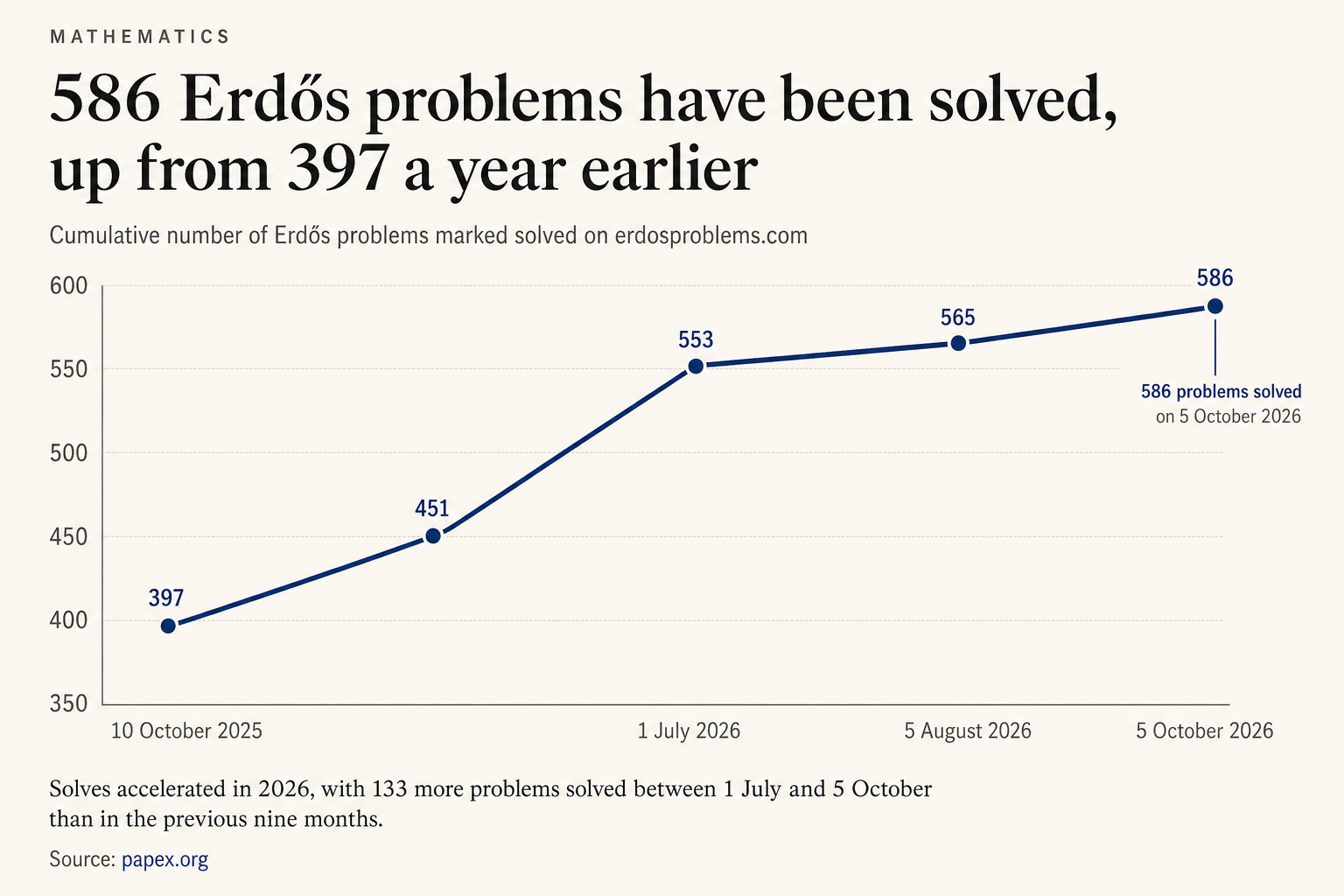
Figure 1: Erdős problems marked solved on erdosproblems.com. Source: [32].
"Solved" here meant only that the site had changed a problem's status, sometimes long after the fact, and the figures mix human and AI work. [32] The counting then stopped. On 6 October Bloom removed the statuses, citing a site increasingly used to "record a (increasingly meaningless) priority claim." [32] Terence Tao's wiki of AI contributions froze on 30 June 2026. By one outside count of its tables, 69 problems had at least one entry in which an AI played the main role and the outcome was a full solution, a figure the wiki itself warns is "not a benchmark." [32] There is no authoritative current count of Erdős problems solved by AI.
The first wave of AI solutions was largely literature search. In October 2025 an OpenAI executive announced that GPT-5 had found solutions to ten previously unsolved problems. Bloom replied that this was "a dramatic misrepresentation": GPT-5 had found references to existing solutions, and "open" meant only that he was unaware of a paper. The post was deleted. [32] DeepMind's own Aletheia study, covering 13 problems, sorted its results with unusual candour. Erdős-397, 659, 935 and 1089 were independent rediscoveries of solutions already in the literature. Erdős-333, 591, 705, 992 and 1105 were identified as already solved. [33] The authors warned of "subconscious plagiarism," in which a model reproduces training knowledge without attribution. [33] Erdős-397 turned out to be nearly identical to a Chinese Olympiad team selection problem. [34] The abstract's tally shifted between versions, from four novel solutions and nine literature identifications to five and eight. [34][35]
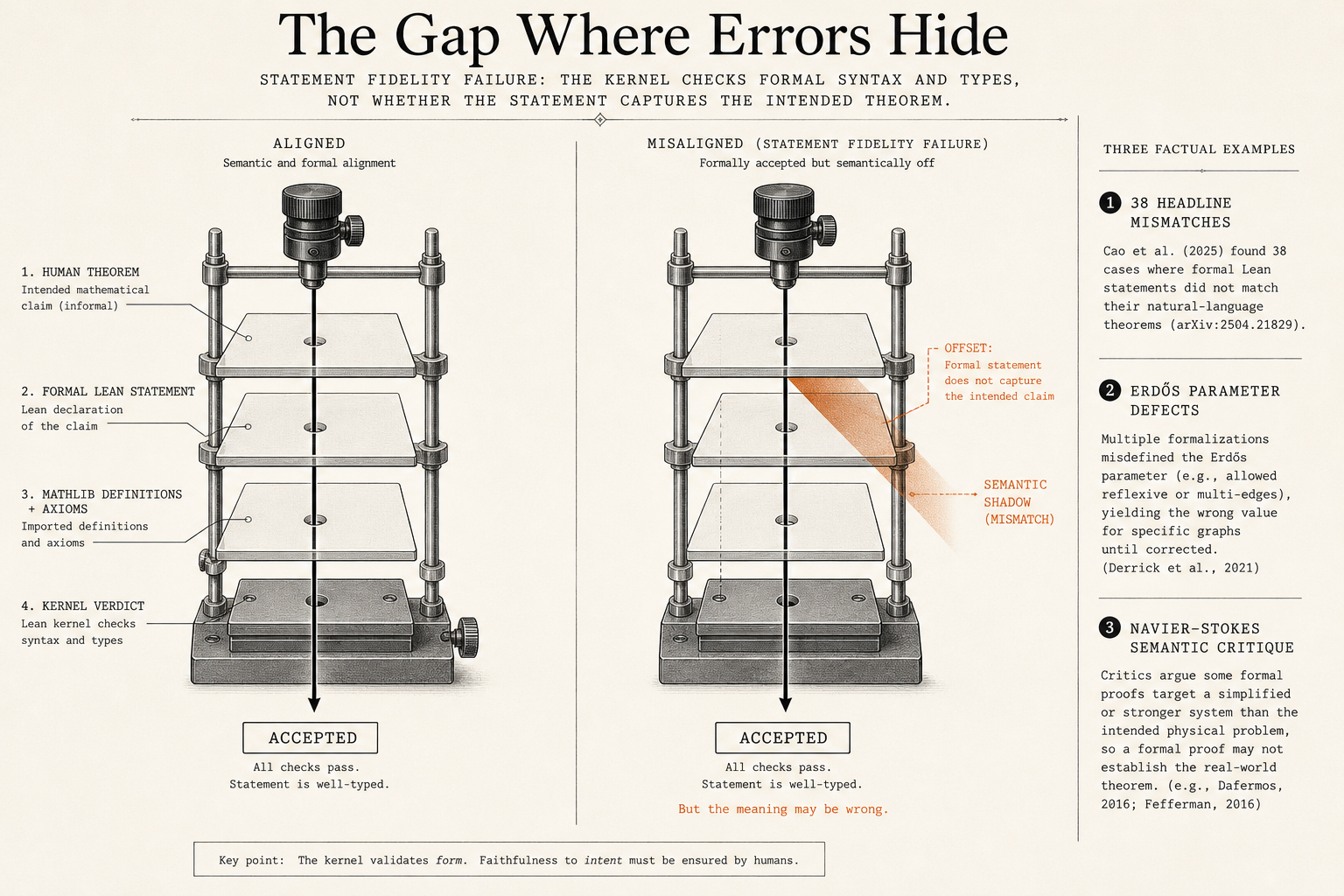
The paper's most useful conclusion concerns statements: "The vast majority of autonomous solutions that were technically correct came from flawed or misinterpreted problem statements." The hardest step for human experts was not verification but finding out whether solutions already existed. "Note that formal verification cannot help with any of these difficulties." [34] Its appendix case study is Erdős-75, where the problem as listed was not the intended one. Erdős's own 1995 formulation was flawed, and the correct statement should also demand that the graph have ℵ1 vertices. [34]
The same issue appears in Lean statements. In November, an audit tracker opened on DeepMind's formal-conjectures repository logged cases where a statement compiled but could not be true. For Erdős problem 975, the placeholder answer was a single real number independent of the polynomial, so "no value of the answer makes the theorem true." [36] Problems 503, 506 and 552 had the same defect: a single number standing in for a quantity that depends on a parameter. [36] An earlier issue found the pattern in problems 142, 319, 321, 361, 409, 503 and 692. [37] In Erdős-525 the stated constant appeared wrong by a factor of two. [36] DeepMind's AlphaProof Nexus agent, which proved 9 of 353 formalized Erdős problems and 44 of 492 OEIS conjectures, found the same kind of flaw from the other side. Its proofs of #125 and #741(i) used "natural density," so the original statements were amended to "lower density" and "upper density." [38] The agent also tried to offload difficulty into a sorry inside a helper lemma, and some lemmas it called established literature proved to be hallucinations. [38]
Against this noise, one case is genuine. On 13 April 2026 Liam Price, a 23-year-old with no graduate training, prompted GPT-5.4 Pro on problem #1196, a 1960s conjecture about primitive sets. [39] About 80 minutes later it produced a proof. [40] The model built it from the von Mangoldt function and a downward Markov chain, a route that decades of experts had passed over. [41][39] Jared Lichtman, who had spent years on the problem, wrote that "barring the initial prose quality, this AI proof is from The Book." [40] An eight-author paper including Tao followed on 1 May. [42] Tao's own account says the problem "was first solved by an autonomous AI query." [43]
OpenAI's October release showed the opposite. On 6 October it posted 722 manuscripts in 372 result families, and the next day withdrew three after a sign error and revised fourteen. [44] Its claimed 42% formalization ratio, according to independent recounts, is closer to 24% or 36%. [45] Buzzard checked the roughly 290 papers with accompanying Lean code and found that 38 "do not even state, let alone prove, the main theorem of the paper." [6] OpenAI had not claimed otherwise. In one case, a claimed proof of Lech's multiplicity conjecture, the formal code proves a corollary rather than the headline result. [6]
Buzzard then named what was new: "If thousands of pages of the literature can be formalized end-to-end by some kind of AI swarm in an 11 day period now, then in the future we will start to see formalization of modern research being done on the fly."
Two claims on one day
The Riemann Hypothesis was not the only claim of 20 November. Tristan Buckmaster of NYU and Alpöge posted a 79-page paper claiming that smooth solutions of the three-dimensional incompressible Navier-Stokes equations can blow up in finite time with no external force, with a Lean formalization of roughly 600,000 lines. [46] The paper says it disproves statements (A) and (B) of Charles Fefferman's Clay formulation. [47] It also says that Claude was used throughout, "and no others." [47]
Its status is cleanly "claimed." It is not peer-reviewed and no independent mathematician has verified it. [47] The numerical certificate the proof depends on has not been released, only a hash of it. [47] Buckmaster himself called the write-up "unpolished and heavily LLM-assisted," saying "After last time, we couldn't risk waiting." [48] A secondary report says Tao's blog described the strategy as an "expected path." [48]
"Last time" refers to OpenAI's 8 September announcement, produced by about 10,000 agents over about 88 hours. That construction used a nonzero smooth external force. [49][50] Clay said on 11 September that the problem "has apparently been settled" but that its evaluation was "deliberately unhurried." [51] Fefferman called the OpenAI result "probably correct." [52] Meanwhile, a Cambridge paper by Bastounis, Circelli and Hansen concluded that OpenAI's Lean formalization "is not a semantically faithful translation of the paper." [53] Buzzard noted that the Lean kernel arena shows OpenAI's Navier-Stokes proof accepted by multiple kernels. [6] Both things are true, and they show exactly where a machine's guarantee ends.
The other 2026 results are better settled. OpenAI's model disproved the Erdős unit distance conjecture in May, and nine mathematicians, including Alon, Bloom, Gowers and Wood, published confirming remarks. [54][55] Daniel Litt called it "the first result produced autonomously by an AI that I find interesting in itself." [54] On 19 July Alpöge and Claude Fable 5 disproved the Jacobian conjecture in dimension three and above, not in two dimensions. [56] Tao posted a "digestion" of the counterexample within two days. [57] Geordie Williamson recalled that "within thirty-six hours, mathematicians had kind of understood where the counterexample comes from." [52]
What stays unsolved, and what may fall first
As of Clay's September 2026 listing, the other four Millennium problems besides Riemann are unsolved. Birch and Swinnerton-Dyer, Hodge, P versus NP and Yang-Mills are all marked so, while Navier-Stokes is marked "active." [58] Reporting from October 2026 puts the Millennium prize fund at $7 million, with nothing paid out. [59]
On Birch and Swinnerton-Dyer, the rank part is known for analytic rank 0 and 1 (Gross-Zagier, Kolyvagin) and for a positive proportion of curves, but no case of analytic rank two or higher is proven. [60] The Hodge conjecture saw Markman's 2025 proof for abelian fourfolds. In October 2026 OpenAI released an unreviewed proof for CM abelian varieties, a special case with no Lean formalization. It later withdrew three related manuscripts, though not that one. [60] A formalization of even the Hodge statement relies on more than 10,000 lines of code on top of Mathlib, because Mathlib lacks the cycle class map. [6] For P versus NP, one commentary notes no AI progress, since the problem offers no partial bound to nudge. [61] For Yang-Mills, even stating the target theorem in a form Lean could check is itself an unsolved problem, according to the same commentary. [61]
Hilbert's list of 23 is only partly closed, and the answer depends on interpretation. Gödel and Cohen showed the continuum hypothesis independent of the usual set theory axioms, yet research continues, and the 2026 ICM featured new work on Hilbert's first and sixth problems. [62][63] Hilbert's problem on prime numbers, which includes Riemann, was listed as unresolved in a mid-2026 table. [64] Of Smale's 18, four later entered the Millennium list, and MathWorld marks problem 2 (Poincaré) proved by Perelman, as noted above. [13][65]
Among the classics, Goldbach has been verified up to 4×10^18 but remains open, and Chen's (1+2) theorem remains the strongest result. [66][67] For twin primes, Zhang's bounded gaps of under 70,000,000 were reduced to 246 by Polymath8. [68] Collatz has Tao's 2019 "almost all orbits" result and nothing stronger. [68] The geometric Langlands conjecture was proved in 2024 in five papers of roughly 1,000 pages. [69][70] The arithmetic version remains open, and Peter Scholze's 2026 Bourbaki talk offered a "template for a conjecture" he called Langlands 2.0. [71] For Hadwiger-Nelson, the chromatic number of the plane, OpenAI's October release claims no five-colouring works. The site now gives bounds of 6 to 7, with a linked formalized proof. [32][16] The invariant subspace problem is open for infinite-dimensional Hilbert space, and only the finite-dimensional case has a Lean proof in the formal-conjectures repository. [72] The Jacobian conjecture remains open in dimension two. [56]
The abc conjecture is the cautionary tale. Shinichi Mochizuki posted a proof in August 2012 using inter-universal Teichmüller theory, and a Kyoto institute published it in 2021. [73] Peter Scholze and Jakob Stix spent five days with him in 2018 and concluded "there is no proof"; Mochizuki called that "a complete misreading." [73] The disputed step is Corollary 3.12, on how volume measurements scale across "universes." [74] As one March 2026 assessment put it, abc is "a theorem in Kyoto, a conjecture everywhere else." [75] An international effort called LANA is attempting machine verification. A July 2026 interim report, as described by one commentator, narrowed the dispute to a single equation about whether two scales created in different ways match, and LANA had not obtained the proof. [76] New Scientist reported in July that the effort had "made no progress." [77] This is what a proof looks like when neither humans nor machines can check it.
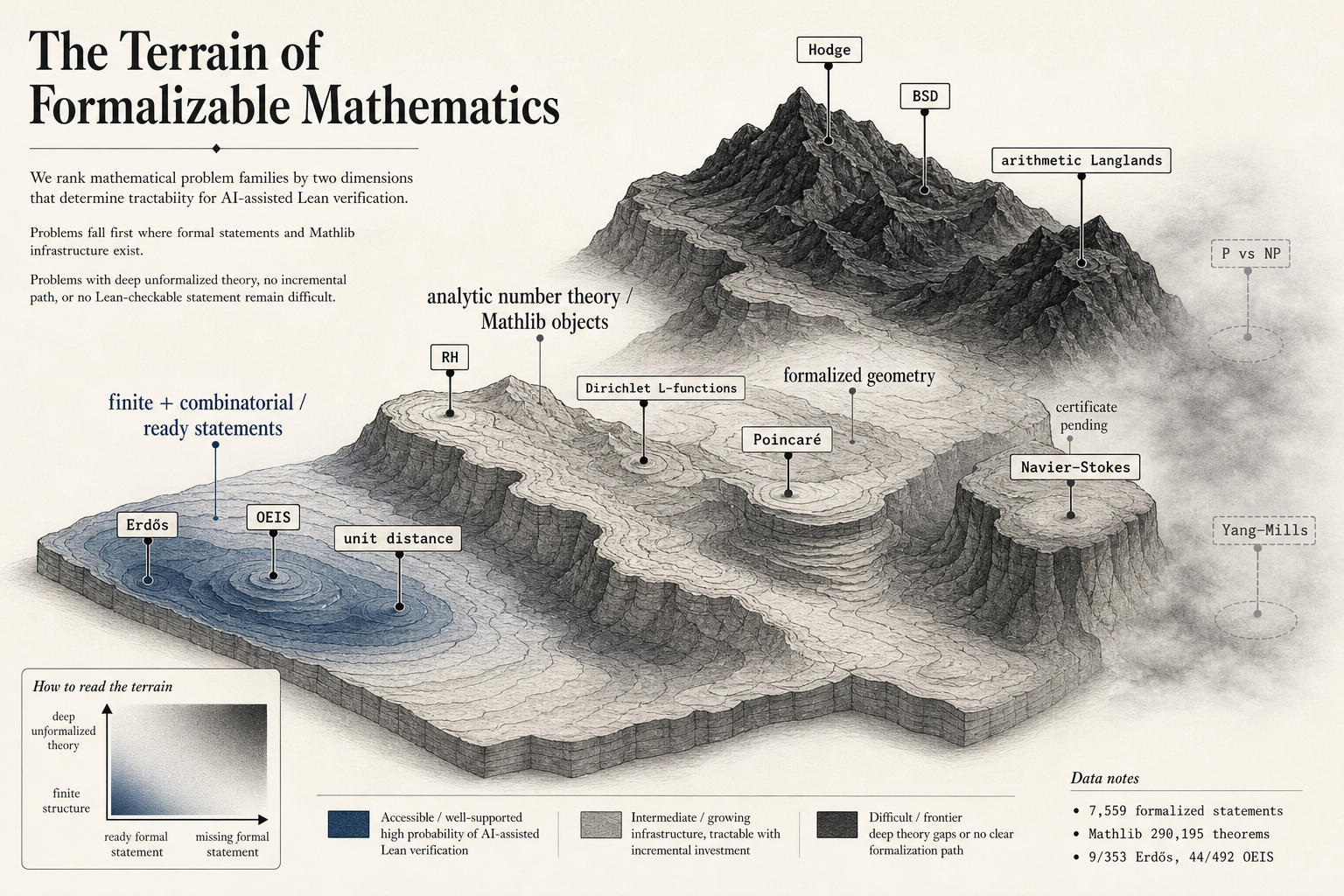
On tractability, the ranking below is an editorial judgement drawn from the cases above, not a measured result. It rests on three questions: how much formal infrastructure exists, how finite or constructive the structure is, and how much unformalized theory lies underneath.
At the top sit finite and combinatorial problems with ready statements in Lean. The formal-conjectures benchmark held 7,559 formalized statements in May, including 1,642 open conjectures. [78] This is where AlphaProof Nexus's nine Erdős results and 44 OEIS results came from, at a reported few hundred dollars per problem in the May preprint. [38] Next come analytic number theory problems where Mathlib already defines the central objects. Riemann is the proof of concept, because Mathlib already held the zeta function, Dirichlet L-functions and a vetted statement. [3][4] Below that are geometry and arithmetic problems that depend on large unformalized theory, such as Hodge, Birch and Swinnerton-Dyer, and arithmetic Langlands. Last are problems with no obvious incremental path or no formal statement, namely P versus NP and Yang-Mills. [61] Navier-Stokes sits wherever its pending certificate puts it. Martin Hairer said at the Royal Society that "many other long-standing mathematics questions will likely be answered in the next few months." [79]
Where the oracle stops
The reason mathematics is special is that a kernel returns a binary, deterministic verdict on every attempt. That is what makes brute search over proof attempts viable "in a way it is not against a human referee." [19] An AI system can be trained and rewarded against that signal at scale. One commentator observed that discovery is getting cheaper while the cost lies in rigorous verification, and that ensuring correctness "often lacks a 'free oracle' like Lean." [25] Other fields have nothing quite like it: a clinical trial, a courtroom or a laboratory experiment has no small, universal, mechanical checker for whether a claim follows from its premises.
The oracle has four limits. The first is statement fidelity. Buzzard's example is a Lean definition of Fermat's Last Theorem over natural numbers that compiles but is trivially false, because zero is a natural number. [6] Sutherland's closing caveat is the same point: a passing check shows that the formal statements, as written, follow from the three axioms, and "relies on those kernels and on Mathlib's definitions being what they are intended to be." [4] An AI audit of the Erdős statements, the Cambridge critique of the Navier-Stokes formalization and the 38 headline mismatches in OpenAI's release all show the same failure.
The second limit is the trusted computing base. In 2026 security researchers using frontier AI found several soundness bugs in Lean's kernel, one of which allowed an illicit Collatz disproof. All were reportedly fixed. [17] Lean shipped another patch on 28 July. [80] Thomas Hales wrote on Tao's blog that "we absolutely cannot put blind trust in systems such as Lean," invoking Ken Thompson's "You can't trust code that you did not totally create yourself." [81] Buzzard's reply is the practical one. There may be more bugs, but "this does not matter," because a malicious proof would have to exploit undiscovered bugs in many independent systems at once. [6]
The third limit is coverage. Mathlib had 290,195 theorems and 137,930 definitions from 772 contributors in early October. [16] That is a great deal and still narrow. The statement of the classification of finite simple groups, as formalized by one AI system, imports over 250,000 lines of Lean, and Buzzard noted he had not met anyone who had carefully checked its sporadic-group definitions. [6]
The fourth limit is human understanding. Alpöge says he intends to "do my best to understand and impart understanding of this argument." [1] Tao has described a coming "proof indigestion," in which verified proofs accumulate faster than anyone can write them up or absorb them. [82] His rule of thumb is that if authors cannot give a clear, expert-level talk on their results, "then the result should not be published." [83] A letter from 25 Fields medallists put it more strongly: "solving problems is only a tool and proxy for achieving the primary goal of conceptual understanding and insight." [52]
That divides the labour. Humans are not needed to check that a formal proof follows from its axioms, to compile it, to replay it through a kernel or to audit its axioms. Those steps are now mechanical. Humans are still needed to decide that the formal statement says what the theorem should say, to digest the argument into something communicable and to judge what is worth proving. The social process of acceptance remains theirs too.
The next prize, the next journal
The institutions are adapting unevenly. Clay's rules are unchanged: publication, two years, general acceptance. [9] A proposed new journal announced on 17 October says that to be accepted "a paper will need to have its proofs formally verified in Lean," and that it will prize understanding over being first. [84] Bloom suggested at the Royal Society that journals could use auto-formalization to check submissions and narrow the referee's job to "do we think other humans will want to read this?" [79] A patchwork of prizes, bounties and registries for Lean proofs has also appeared. [85] The Leiden Declaration, published on 2 June 2026 and endorsed by the International Mathematical Union, lists five threats to the field, among them correctness and incentives, and makes 23 recommendations. [80][82] A new Association for Human Mathematics already has more than a thousand members who have committed not to work with AI companies. [79] An independent advisory group asked frontier labs to stop testing advanced problems on proprietary models. [86]
Mathematicians' own words register the shock. At the Royal Society on 29 October, Ben Green called it "a summer like no other." Miranda Cheng said it was "probably the end of mathematics as we know it." Timothy Gowers called for a contingency plan for the discipline. [79] Tao said "for the first time in history we are running out of problems to solve." [87] Buzzard struck the optimistic note: mathematics "is infinite," which "beats exponential hands down." [86]
The Riemann Hypothesis may well be true and the proof sound. The kernels agree on that, and few mathematicians are betting against the checkers. What the episode establishes is a division of labour that mathematics has never had before. Truth can now be certified cheaply and overnight, while understanding, the thing mathematicians say they actually want, has become the scarce resource. The next fall will probably arrive the same way, as a pile of code that checks, to be read afterward by people who must decide what it means.
- Together they show something new: correctness and comprehension have come apart.
- A mathematician can read a few thousand lines of kernel.
- Humans are not needed to check that a formal proof follows from its axioms, to compile it, to replay it through a kernel or to audit its axioms.
- Humans are still needed to decide that the formal statement says what the theorem should say, to digest the argument into something communicable and to judge what is worth proving.
Get the next issue in your inbox.
Free, weekly. One company or market, taken completely apart — every figure sourced and verified with Valyu DeepResearch.
Issue queued.
Your next cited briefing is on its way to .