
On the evening of Thursday, October 15, 2026, at SpaceX's rocket test site in McGregor, Texas, a Tesla Roadster drove up an inverted curved ramp and stayed there, pinned upside down by suction fans.
A Few Seconds Above Texas
It then left the ramp on bursts of compressed air, rolled roughly 180 degrees in the air and landed on its wheels. A second demonstration launched it over a row of Tesla vehicles, which TechCrunch listed as a Cybercab, a Cybertruck, a Semi, a Model Y and a Model 3. A third was a flip from a standstill [1] [2] [3].
Nobody was inside. Elon Musk said the car had no driver "to make sure we don't kill anyone," that success was "not guaranteed," and that it was "not necessarily a safety-optimized car." He also said, "Flying cars are real," and conceded he was "not sure it's necessarily legal in all jurisdictions" [4] [3]. After one short hop he remarked that it "was just a little flight" and that the next should be longer [5].
The event was a spectacle, and it raised a real question. If a car can leave the ground, what would flying cars have to accomplish before ordinary life is meaningfully better? Answering that requires keeping two kinds of machine apart. One is the Roadster: a ground vehicle with a stored burst of thrust. The other is the sustained-flight aircraft built by Joby, XPeng and others, which can stay up long enough to carry someone somewhere. Almost every confusion about flying cars comes from blurring them.
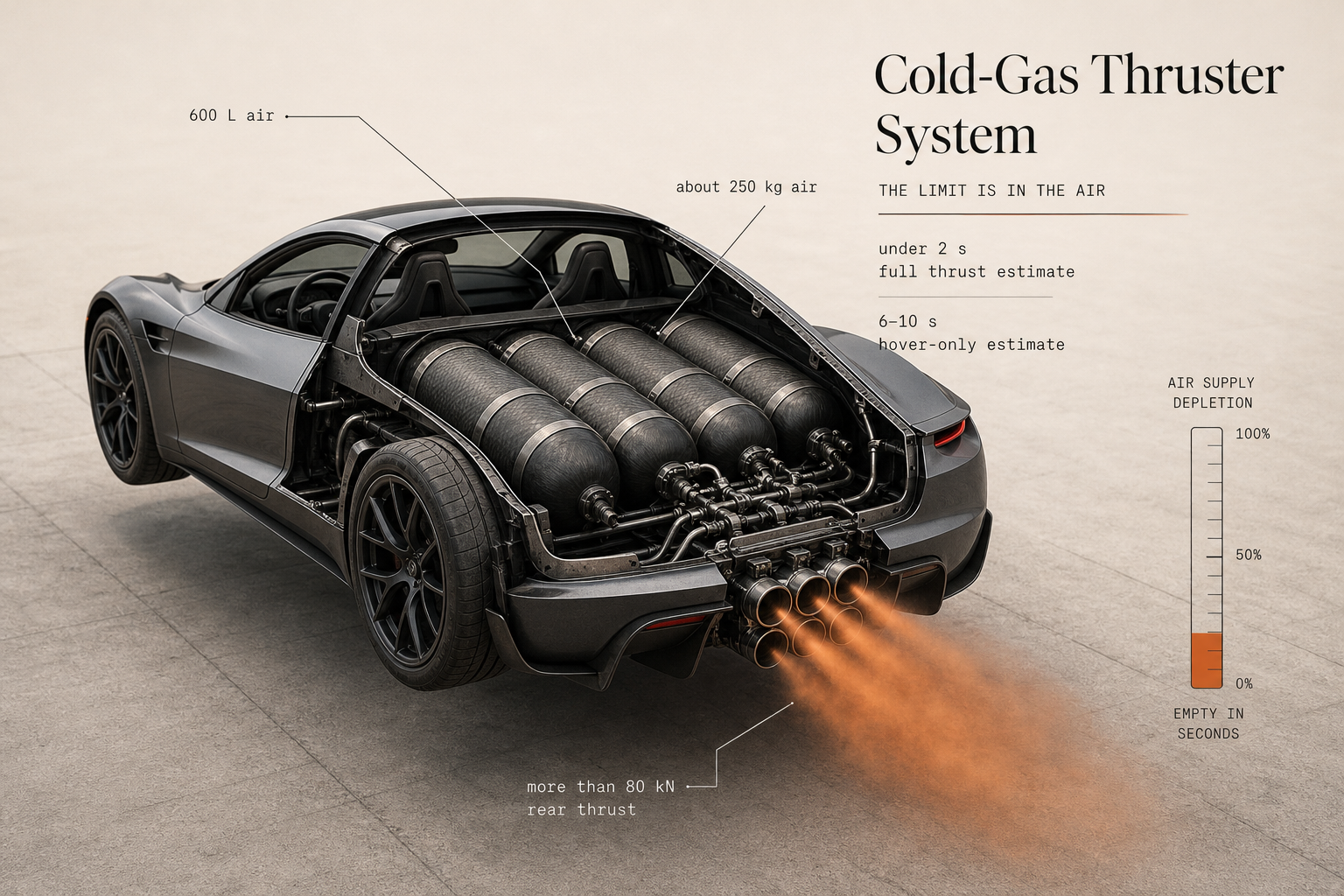
The Roadster's mechanism is a cold-gas thruster system. Compressed air is stored in carbon-overwrapped pressure vessels and released through nozzles, and the escaping gas pushes the car the other way. Tesla's engineers described ten thrusters fed by 600 litres of air; WIRED alone reported four [1] [3]. Tesla claims the rear thrusters produce more than 80 kilonewtons, and an on-stage readout showed about 5,500 psi [6] [7]. Moravy put the air at about 250 kilograms [7]. Tesla has published no flight duration, altitude or refill time, and no outlet reported any [8].
Those stated figures are enough for a rough calculation, with the caveat that it is an estimate and not a Tesla number. Assume an effective exhaust speed of 530 to 693 metres per second, which is typical for compressed air. At 80 kilonewtons the nozzles then consume roughly 115 to 150 kilograms of air every second, and 250 kilograms lasts under two seconds at full thrust. Simply hovering a car of 1,700 to 2,350 kilograms (Tesla has published no curb weight) needs about 17 to 23 kilonewtons. That cuts the draw to roughly 28 to 43 kilograms per second, and the tank empties in between about six and ten seconds [9] [10]. The Roadster, in other words, has a few seconds of air and an extraordinary amount of thrust to spend in them.
What 2019 Promised, and What 2028 Does Not
The demonstration matches a promise Musk made in plain view. In June 2018 he wrote that a SpaceX option package for the new Roadster would include about ten small rocket thrusters, adding, "Maybe they will even allow a Tesla to fly" [11]. In January 2019, when Marques Brownlee said he felt Musk was not joking, Musk replied: "I'm not." He said the car would use a SpaceX cold gas thruster system with ultra-high-pressure air in a composite overwrapped pressure vessel in place of the two rear seats [12]. The 2026 machine did what that post described. Business Insider noted the technology was as he described it [12]. On Joe Rogan's podcast in late October 2025, Musk had promised the demonstration would be "unforgettable" [13].
What changed between the post and the stage is the claim's size and its schedule. In 2019 the claim was a mechanism and a hint. In 2026 it is "flying cars are real," delivered by an unoccupied car launched from a ramp. The 2017 Roadster reveal had promised deliveries in 2020 [14]. The reveal itself slipped, to April 2026 and then to October, and Tesla now says production begins in 2028 [1] [2].
The 2028 target promises less than it appears to. It promises a production start for a car sold in three trims. Performance is road-ready with two seats. Thrust has two seats and rear thrusters. Rocket is one seat, "air ready" and invite-only [1] [3] [6]. It does not promise a price, which was not announced, or any flight range or duration. It does not promise a certification path, and the sources reviewed report no FAA filing. Tesla's own site lists the Rocket as not approved for public road use [2]. Analyst Dan Ives said the Roadster would "not move the volume or revenue needle" [2].
Even by its own logic the Roadster is a stunt platform. A single seat, seconds of thrust and a refill measured in hours (a third-party estimate with an 11 to 20 kilowatt compressor, low confidence) do not add up to transportation [9]. The rest of this article asks what does.
Why Hovering Is the Expensive Part
Leaving the ground is the easy half of flight. Staying up is where cost accumulates, and the physics explains why the Roadster and a real air taxi differ so sharply.
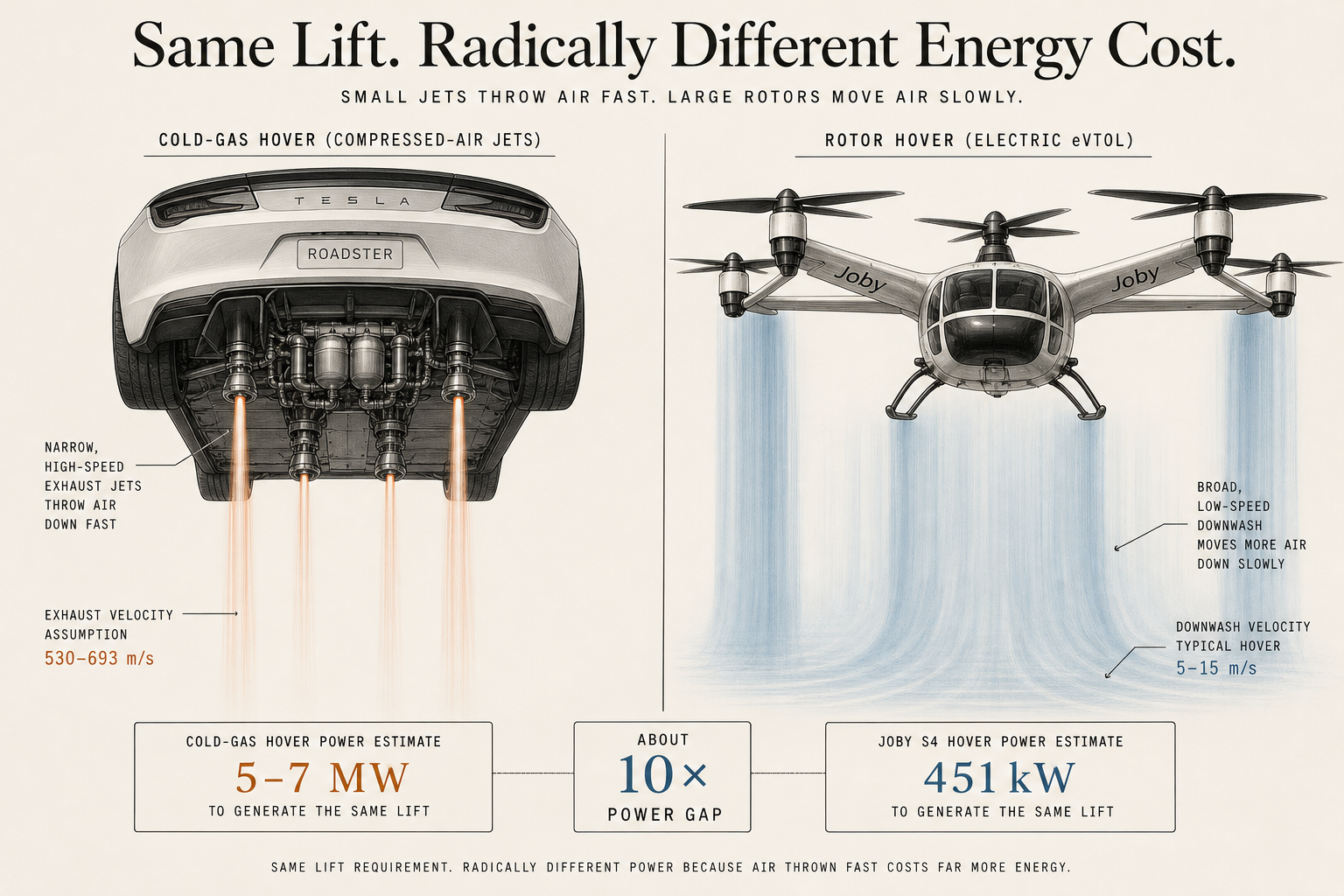
A rotor holds an aircraft up by pushing air downward. The ideal power needed in hover is the thrust multiplied by the speed at which that air is accelerated through the rotor, the induced velocity. That velocity falls as the rotor area grows: it equals the square root of the disk loading (weight divided by rotor area) divided by twice the air density [15] [16]. Large rotors move a lot of air slowly and waste little energy. A small exhaust moving very fast wastes a great deal, because the kinetic energy carried off in the jet grows with the square of its speed.
Applied to the Roadster, a 2,000-kilogram car hovering on exhausts at 530 to 693 metres per second needs jet power of roughly 5 to 7 megawatts, from a straightforward momentum calculation using the assumed figures above. Joby's S4, a six-rotor aircraft of about 4,800 pounds, is estimated at 451 kilowatts in hover [16]. The comparison is rough, but the order of magnitude is the point. Cold-gas hover spends ten times the power of a rotor doing the same job. That is acceptable for a one-second stunt and unthinkable for a journey.
Even for rotor aircraft, hover is the costly phase. One 2022 rotorcraft-theory study estimated hover and cruise power for three designs. A large-rotor two-seat multicopter, the Volocity, needs 116 kilowatts in hover against 91 in cruise. Joby's S4 needs 451 against 114, and Beta's Alia 250 needs 724 against 168 [16].
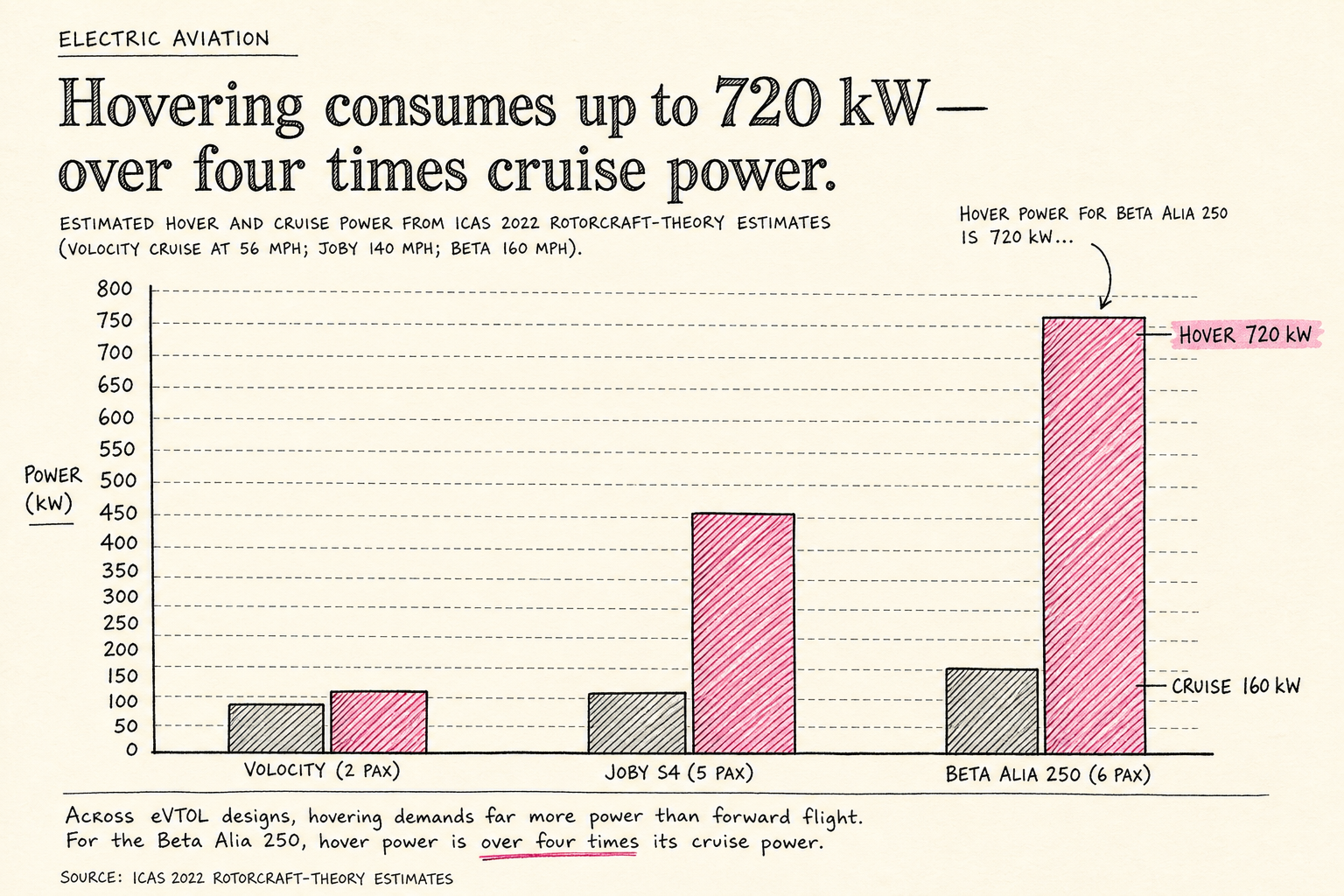
The chart shows the central tension of vertical flight. Designs that cruise efficiently on wings, like the S4, pay for it with small, highly loaded rotors that are expensive in hover. A design with large rotors, like the Volocity, hovers cheaply but drags through cruise. In the Michigan analysis of a 100-kilometre trip, hover power was 250.6 kilowatts against about 59.7 in cruise, and a single minute of hover, split between takeoff and landing, cost 40.9 megajoules of primary energy [15].
The consequence reaches into reserves. A European air-traffic study found that a ten-minute hover phase can cut range by up to 75 percent, depending on configuration. About 10 percent is lost at two minutes and up to 30 percent at five. Cold weather near 0 degrees Celsius costs roughly 20 percent of range [17]. A diversion, a wait for a landing slot or a gust that forces a go-around all spend the most expensive minutes in the whole flight.
A Century of Cars That Could Fly
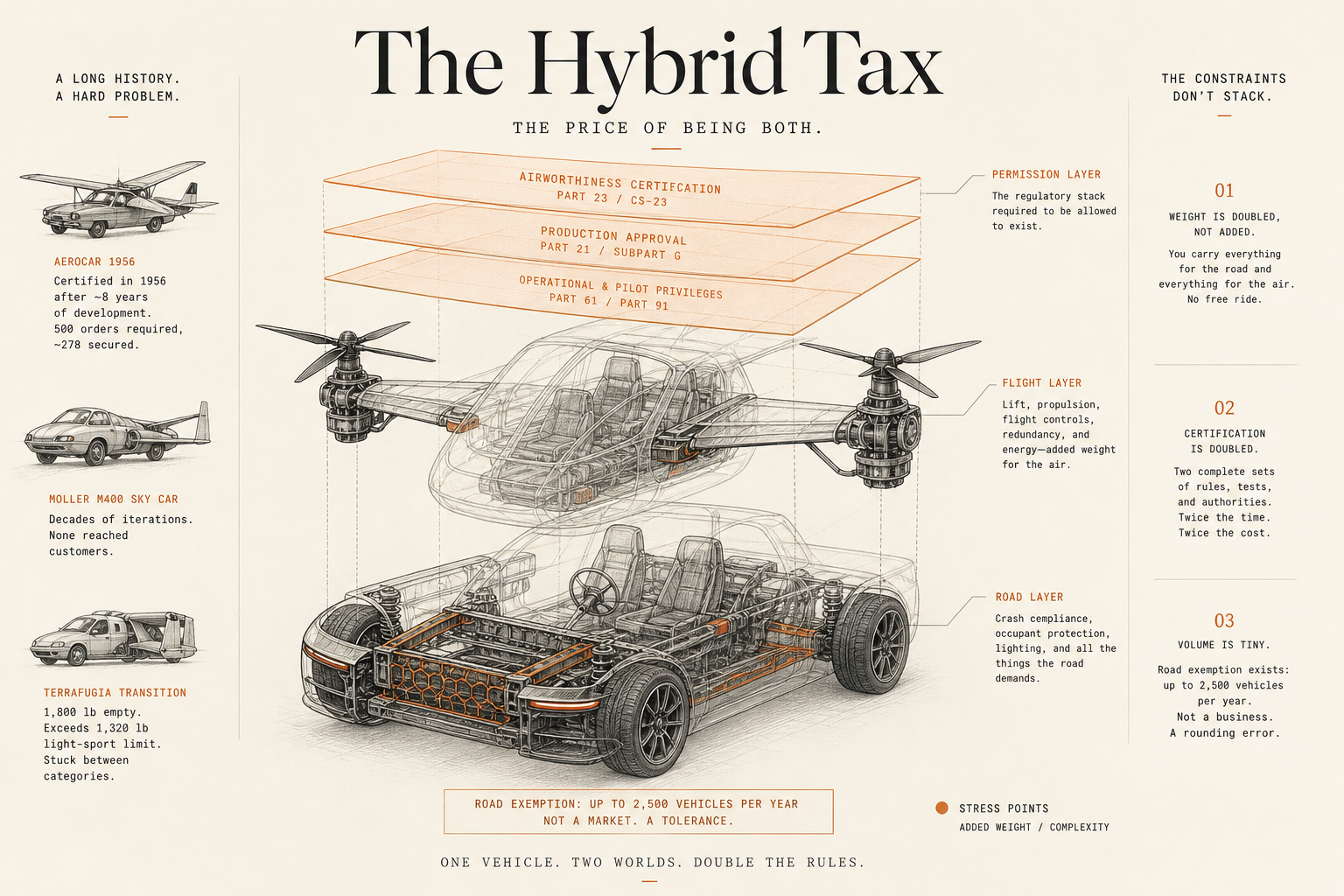
The history of flying cars shows that lift was never the obstacle. In 1949 Moulton Taylor's Aerocar made its first public flight in Longview, Washington. It won a Civil Aeronautics Administration type certificate in December 1956, after roughly eight years and about $750,000 of effort [18] [19]. It could fly and drive. It failed commercially. A deal with Ling-Temco-Vought required 500 orders and secured about 278 [20] [18]. In 1970, Ford studied a flying-car programme at an estimated 25,000 units a year and declined, citing federal safety and environmental rules and the prospect of many private aircraft over cities [19].
The Fulton Airphibian was certificated in 1952, and eight production models were built for civil aviation inspectors. None were delivered, and investors withdrew in 1953. The National Air and Space Museum records that prototypes made more than 6,000 car-to-plane conversions, that some judged the conversion too complicated, and that combining aviation and automotive technology in a marketable form "proved to be elusive" [21].
The Convair Model 118, flown in November 1947, made a forced landing three days after its first flight when it ran out of fuel, reportedly after the pilot checked the car's fuel gauge instead of the aircraft's. The programme was cancelled, with two built [22] [23].
Terrafugia's Transition belongs to the modern era but tells the same story. Its first flight came in 2009, and promised deliveries slid from 2009 to 2011 to 2012 [24]. The FAA granted a special light-sport airworthiness certificate on January 26, 2021, and within weeks Terrafugia pulled the US operation amid reported layoffs [25]. Car safety rules had pushed the vehicle to about 1,800 pounds against a light-sport limit of 1,320, which required an FAA exemption [25].
The pattern is a compromise built into the object. An aircraft wants to be light, and a car wants to survive crashes. A vehicle with both systems carries the weight of each, answers to two regulators, needs two kinds of licence and sells in tiny volumes that cannot amortise two certifications. Popular Science quoted critics who feared such a machine "could wind up a mediocre version of both" [26]. Ground vehicle, flying machine and the cost of certifying each: that is the hard problem, and a ramp launch does not touch it.
Two Ways to Fly, One Way Not To
Tesla's approach is a car that gains a brief aerial trick. XPeng's affiliate Aridge, formerly XPeng AeroHT, takes the opposite route and moves the compromise into a detachable joint. Its Land Aircraft Carrier is a six-wheeled, extended-range ground vehicle of 5,500 millimetres in length, seating four, which carries a separate two-seat, six-rotor air module [27]. The car stays a car and the aircraft stays an aircraft, but each needs its own approvals. Aridge says full charge and fuel support five to six flights, and deployment takes about five minutes [27] [28]. The price is capped under 2 million yuan, with about 7,000 orders reported, roughly 600 of them from the Middle East [27] [29]. Its Guangzhou factory rolled out the first flying module on November 3, 2025 [30].
Aridge has no certificate of any kind. The Civil Aviation Administration of China accepted its type certificate application in March 2024. On July 22, 2026 it placed Aridge on a fast-track compliance list, which streamlines procedures but is not an approval [31] [32]. Late-2026 deliveries were repeated through the year. A September report from the IFA exhibition in Berlin says they may slip to 2027, but it comes from an aggregator and I could not confirm it from the company [33].
Before any of that, on September 16, 2025, two AeroHT aircraft collided during a rehearsal for the Changchun Air Show. The company attributed the collision to "insufficient separation distance," and one aircraft caught fire on landing [34].
Toyota-backed Joby is the other pole. It builds a piloted, all-electric aircraft carrying a pilot and up to four passengers, or about 1,000 pounds, at up to 200 miles per hour over up to 100 miles [35]. It has no wheels. Joby entered the final stage of FAA certification on March 11, 2026, when flight testing of its first conforming aircraft began, and no type certificate had been issued as of its September 10 release [36] [37]. Toyota's total commitment is $894 million, following a $500 million announcement in October 2024 [38]. On June 30, 2026 the two firms formed a manufacturing venture, 51 percent Toyota and 49 percent Joby, intended to become the exclusive builder of the S4 [39]. Joby's first Dubai vertiport, at Dubai International Airport, was certified on July 6, 2026 [40]. Joby has said it expects its first passengers "later this year" there, and the sources reviewed here confirm no passenger service as of October 16 [41] [36].
The financial arithmetic is sobering. Joby's six-month net loss to June 30, 2026 was $355.4 million, with operating cash use of $317.6 million. It held $636.1 million in cash and restricted cash plus $1,634.0 million in short-term investments [42] [43]. Even the leader is spending a billion dollars of runway to approach a first commercial route.
The graveyard around them is crowded. Audi, Airbus and Italdesign showed the Pop.Up Next in 2018. By October 2019 Audi had stopped work, saying it would be "a very long time" before a serially produced air taxi could avoid making passengers change vehicles [44]. Lilium entered insolvency in October 2024 and again in February 2025, and its patents sold to Archer for €18 million [45] [46]. Volocopter filed in December 2024 and was bought by Diamond Aircraft and Wanfeng in March 2025 [47] [48]. Airbus paused CityAirbus NextGen in early 2025 over battery maturity [49]. Hyundai's Supernal paused its aircraft programme in September 2025 after its CEO and CTO left and about 5 percent of staff were cut [50] [49].
The Roadster does not belong in either camp. It is neither a certifiable sustained-flight aircraft nor a modular system with a certification application in progress.
The Whole Journey, Four Ways
The question is not how many minutes a vehicle spends airborne. A passenger's journey includes reaching a takeoff site, preparation, waiting, boarding, flight, landing and the final connection. One modelling study of Munich, Paris and San Francisco found that each access or egress leg may be up to a third of total trip length, so together up to two-thirds of the journey happens on the ground. It judged urban air mobility unsuitable for mass transport, though useful as a helicopter alternative for occasional or emergency trips [51].
The congested commute. The experience is real: US workers who commute without working from home averaged 27.2 minutes one way in 2024, and 9.3 percent travelled 60 minutes or more [52] [53]. But the longest commutes are mostly rail and ferry journeys, which average 71.0 minutes, against 26.5 for solo drivers [53]. Air capacity cannot serve them. Simulated vertiport turnaround is about ten minutes under ideal conditions, with a six-pad vertiport reaching congestion near 1,200 arrivals a day [54]. The same modelling work found that air travel would reduce travel time for only 3 to 13 percent of motorised trips [51]. The vehicle category here is a train, a bus or road pricing, not an aircraft, and the Roadster has no role at all.
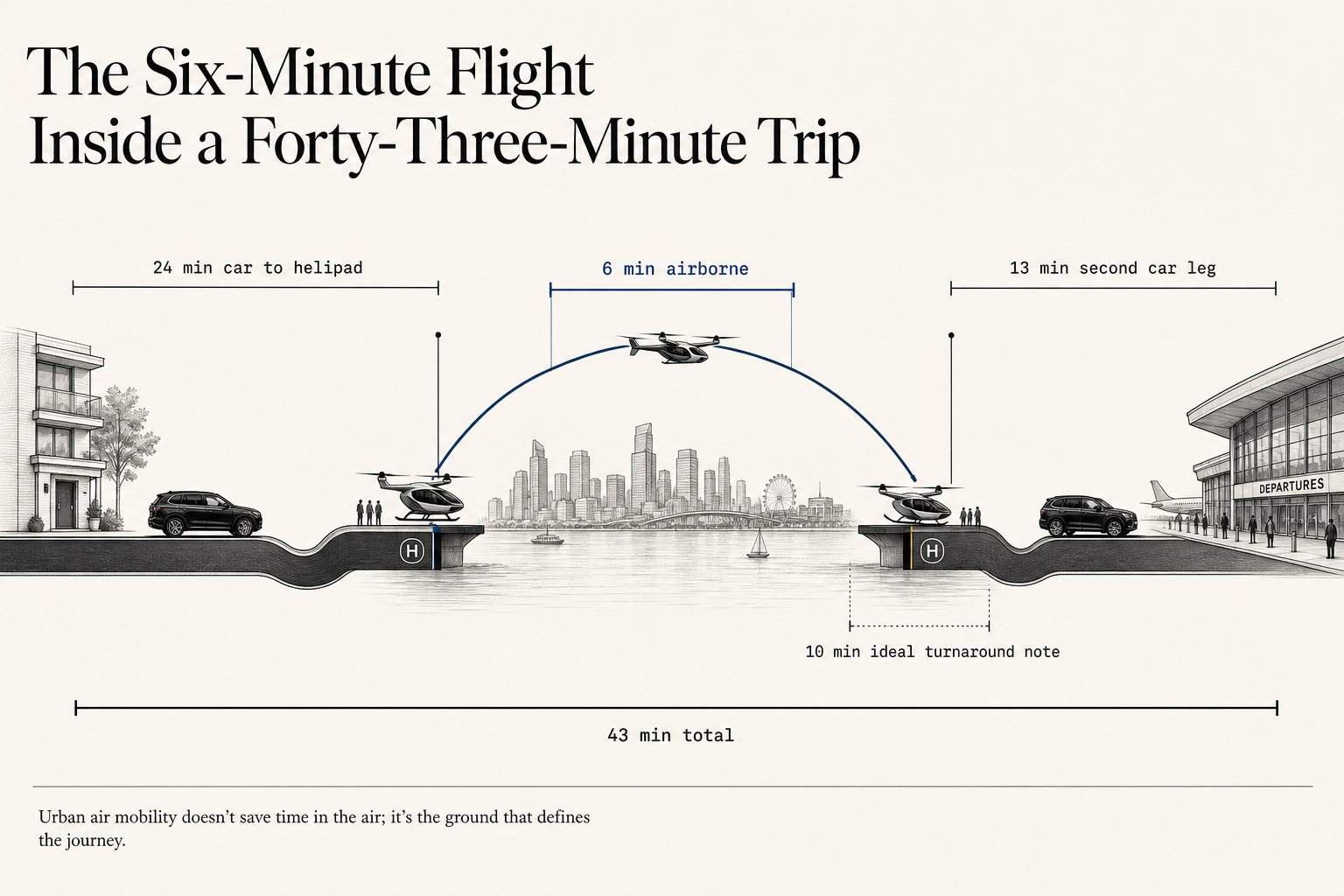
The airport transfer. This is where helicopters already operate and eVTOLs aim. Blade's Manhattan to Kennedy flight takes about five minutes at $195 per seat [55]. Blade's own pages cite a test with a 24-minute car ride to the helipad, a six-minute flight and a 13-minute second car leg, 43 minutes in all, set against an hour or more by road at peak [56]. Joby's Dubai route is projected at 10 to 12 minutes against 45 by car [57] [58]. Those are projections, since no passenger flight had operated by mid-October 2026. A train or subway, where one exists, is far cheaper, and a helicopter wins only when the roads are at their worst. Blade's last full-year filing shows the scale of the niche: 94,733 seats flown in 2024 [59]. The right vehicle is an eVTOL or helicopter with a pad at the airport and one at the destination, and ground legs decide whether it pays.
Water and mountains. Here air has the strongest claim, until fixed links arrive. Between Nice and Monaco, Blade and Monacair sell seats from €195 for a seven-minute flight over 18 kilometres. By car the trip takes about 45 minutes on a good day and over an hour at peak, while the train takes 20 to 25 minutes for €4 to €5 [60] [61] [62]. The 57-kilometre Gotthard Base Tunnel, which cost 12.2 billion Swiss francs, made Zurich or Basel to Milan about an hour faster [63] [64]. The Øresund bridge replaced a ferry of about an hour with a train of 34 to 35 minutes [65]. Where no tunnel or bridge exists, a helicopter or eVTOL offers a real saving. Once a fixed link opens, it generally wins on cost and reliability, and the air alternative narrows to a premium or emergency role. Joby's range of up to 100 miles suits these hops, but weather and reserves limit how often the aircraft can fly them [35] [17].
The time-critical medical journey. Evidence for helicopter emergency services is real but narrower than the intuition. In a cohort of 223,475 adults, propensity-matched analysis found a mortality benefit of about 1.4 to 1.5 percentage points, equivalent to treating 65 to 69 patients to save one [66]. A later study found the benefit concentrated in transports of 6 to 30 minutes, peaking at 16 to 20, and suggested it may reflect the crew's care more than the speed [67]. Helicopters beat ground ambulances once distances reach roughly 7.7 miles in one registry, and only past about 45 miles when dispatched non-simultaneously in another [68] [69]. And the aircraft are dangerous: a 2021 analysis put the emergency-helicopter accident rate at 3.04 per 100,000 flight hours, and found darkness and visibility strongly associated with fatal crashes [70].
For eVTOLs the constraint is payload. A NASA white paper notes that medical equipment and personnel add to empty weight, limiting range and endurance, and that near-term eVTOLs carry up to five people at about 200 pounds each over up to 60 miles plus reserve [71]. A modelling study of 6,217 cardiac-arrest cases found that one or two VTOL ambulances could cut arrival times for advanced life support from 21 minutes to 7 to 9 in Paris [72]. The promising niche is putting a paramedic or defibrillator on scene quickly. No certified stretcher-capable eVTOL appears in the sources reviewed. The Roadster's Rocket trim, a single seat with no medical capability, has nothing to offer.
In January 2019, when Marques Brownlee said he felt Musk was not joking, Musk replied: "I'm not."
What Flight Costs the People Below
Weather, payload and reserves bind first. Noise comes next. NASA-supported testing of a Joby prototype, reported by the company, recorded 45.2 A-weighted decibels overhead at 1,640 feet and 100 knots, and below 65 at 330 feet during takeoff and landing [73]. Helicopter comparisons vary by distance, such as about 87 decibels at 500 feet from industry data [74]. An analyst noted that a 25-decibel reduction is perceived as only about six times quieter and that the aircraft remain "clearly audible in absolute terms" [75]. Joby's own filing warns that the aircraft "may have a higher noise profile" than estimated [35].
Downwash is less discussed. The FAA's vertiport brief defines a caution area wherever airflow may reach 34.5 miles per hour [76]. FAA measurements of eVTOLs under 6,500 pounds recorded an instantaneous peak of about 100 miles per hour at 41 feet from the pad centre, with speeds above 60 recorded at 100 feet [77]. Joby's own analysis found a maximum of 55 miles per hour at about 70 feet and no increased risk over light helicopters [78]. The sources diverge on method, and the Roadster's supersonic exhaust has no published blast data.
Pressure vessels and batteries are the stored-energy hazards. NASA describes composite overwrapped pressure vessels as a metal liner wrapped in composite, in which leak-before-burst protects only the liner and stress rupture can occur suddenly at operating pressure, producing overpressure and fragmentation [79] [80]. SpaceX itself lost a Falcon 9 in September 2016 when one of three helium vessels failed, an investigation concluded, because oxygen trapped under the carbon overwrap likely ignited [81] [82]. A Roadster tank holds air, not liquid oxygen, so the cause is not shared. The lesson is only that these vessels have a failure mode that cannot be tested out of a prototype, and the Roadster's liner and qualification have not been published [7].
The battery analogue arrived this week. On October 12 and 13, 2026, a thermal runaway in 30 cells at Archer Aviation's San Jose battery lab injured three people and led to the evacuation of about 100. Archer attributed it to employee error and said the aircraft was not involved [83]. EASA treats propulsion-battery thermal runaway as a catastrophic failure condition unless continued safe flight is shown [84]. An uncrewed Vertical Aerospace prototype crashed in August 2023 after a propeller blade detached; investigators traced it to an adhesive bond failure, and no one was hurt [85].
Permission is the last layer. US powered-lift aircraft are certificated as a special class, and under the 2024 rule pilots need a type rating for each aircraft [86] [87] [88]. Light-sport rules exclude powered-lift altogether [89]. On the road, a vehicle needs federal safety-standard compliance or a temporary exemption of up to 2,500 vehicles per year [90]. I found no source confirming a combined aircraft and road pathway, so a flying Roadster would need both, by analysis, not by precedent. Insurers say the lack of loss history complicates cover for eVTOLs, though some already insure firms before certification [91] [92]. The sources reviewed here do not address accessibility standards.
Is Electric Flight Automatically Greener?
The answer depends on occupancy, trip length and the grid. A University of Michigan analysis of a 100-kilometre trip found that with one occupant a VTOL emits 15.7 kilograms of carbon dioxide equivalent, against 12.3 for a battery car and 24.3 for a petrol car, 35 percent below the latter and 28 percent above the former. With three passengers, measured per passenger-kilometre against cars carrying 1.54 occupants, it is 52 percent below the petrol car and 6 percent below the battery car. It matches the petrol car at about 35 kilometres, and the grid dominates the sensitivity. That study counted use only [15].
A 2025 life-cycle assessment reached a harsher verdict. A four-seat eVTOL on a 100-kilometre trip emits about 0.24 kilograms per passenger-kilometre, 2.4 percent above a petrol car and 104 percent above a battery car. Its propulsion energy is 3.5 times that of a comparable road EV [93]. The two results conflict because their scope differs, one counting use only and the other the whole life cycle, and because their assumptions on occupancy, batteries and loading differ. The honest summary is that a full aircraft on a long trip over a clean grid can beat a car, and a half-empty aircraft on a short hop does not.
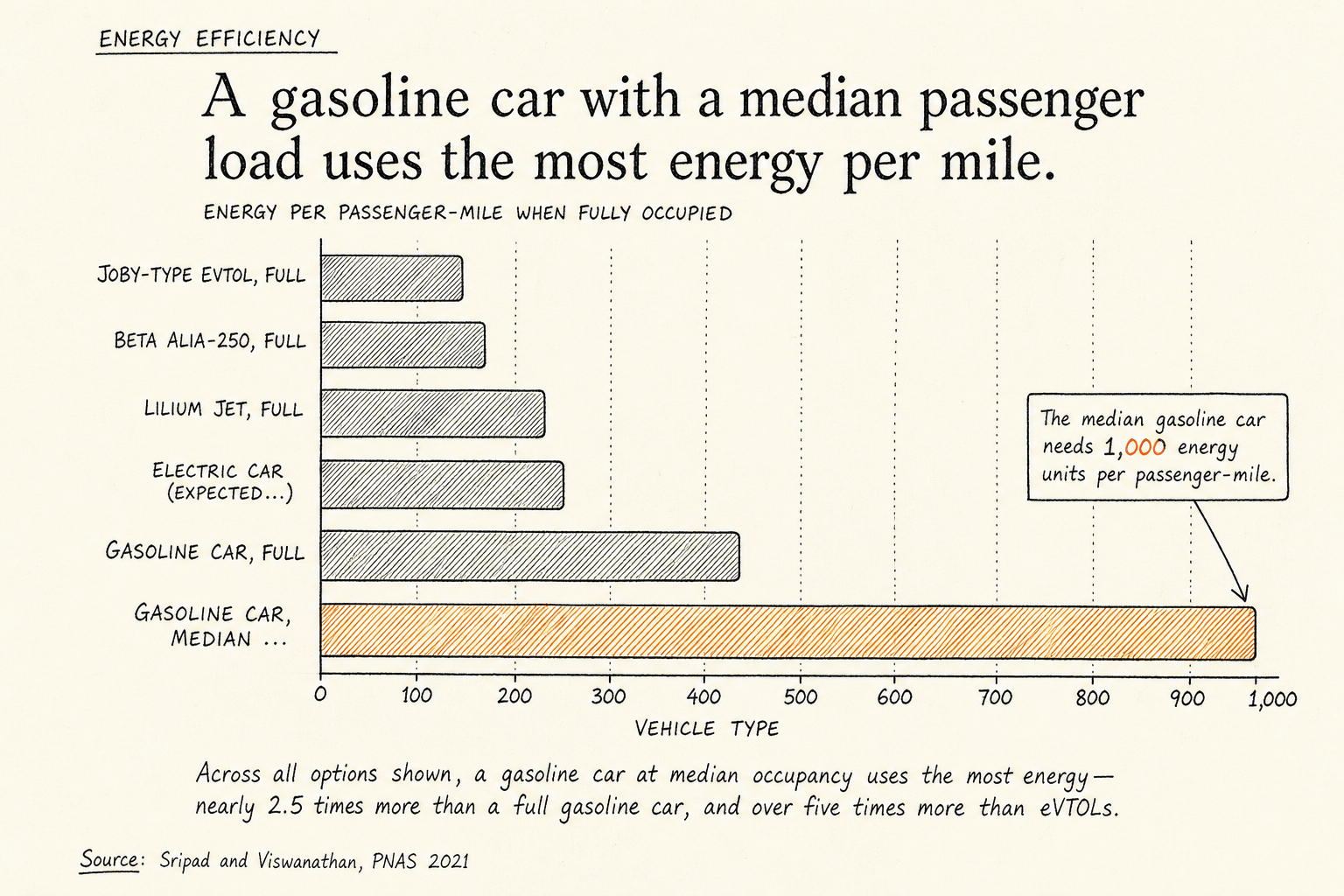
Even the favourable energy comparison assumes full seats. At design range and full occupancy, a Joby-type aircraft uses about 156 watt-hours per passenger-mile and Beta's Alia 250 about 161, against 223 expected for an electric car and 420 for a full petrol car [94]. The empty repositioning that on-demand service requires erodes this, and the life-cycle study found that 10 percent dead-end trips raise emissions by 8.3 percent [93]. I found no primary source for helicopter energy per passenger-mile. The Roadster's thruster hop has no energy case at all.
Where the Saved Minutes Go
If flying did save time, travel history suggests the time would not stay saved. Yacov Zahavi proposed that people hold their daily travel time roughly stable and spend added speed on distance. Mokhtarian and Chen's review found that travel time expenditures are not constant except perhaps at the most aggregate level, though it notes the speed-induced-distance argument [95]. Duranton and Turner found that US vehicle-kilometres rise proportionately with interstate lane-kilometres, an elasticity of 1.03 in their preferred estimate, and that public transit showed no detectable effect on driving [96] [97].
Cheap speed becomes distance, in the same way that extra road capacity becomes extra traffic. My inference, not a measured result, is that an air service meaningful enough to shorten a commute would lengthen it. People would live farther out, employers would expect longer reach, and the remaining benefit would flow to whoever flies first. The status effect is already visible. New York received about 59,000 helicopter complaints in 2023, up from about 26,000 in 2022, according to a council report cited in an op-ed [98]. In September 2026, Kearny, Hudson County and four municipalities sued a New Jersey heliport and its operator, alleging that nearly a quarter of flights occur outside permitted hours [99]. Those are plaintiffs' allegations. A helicopter crash into the Hudson in April 2025 killed six, and the NTSB has not yet issued a final cause [100].
When Flying Cars Would Actually Help
The Roadster's performance on the night was real, and it matters for what it is: a very fast car with a stunt capability, produced by two companies that are good at pressure vessels. It does not advance the question of sustained flight, because holding a vehicle up needs large, slow-moving air, certified machines, trained pilots, places to land and neighbours who agree.
Flying cars improve mobility under specific conditions. The route must lack a fixed link or have a slow, congested one. The origin and destination must both have pads, so ground legs stay small. Seats must fly full and the grid must be clean. The aircraft must hold weather and reserve margins for the whole route. Noise and downwash must be tolerable to the people underneath. And the trip must be short enough or the passenger important enough to justify a cost that, at $195 a seat today, is a premium.
Those conditions describe a premium niche: airport transfers, island hops, mountain gaps, and emergency placement of paramedics. They do not describe the commuter, who is mostly served better by fixed infrastructure and by not travelling. Where the conditions fail, flying simply moves the costs overhead: to the neighbours' ears, to the grid, to the time spent reaching a pad, and to the insurer. The Roadster, for now, asks for none of this, because it flies for seconds and carries nobody. When the first sustained-flight passengers board in Dubai, the question will be not whether the machine rises but who pays for everything else.
- The Roadster, in other words, has a few seconds of air and an extraordinary amount of thrust to spend in them.
- Cold-gas hover spends ten times the power of a rotor doing the same job.
- Ground vehicle, flying machine and the cost of certifying each: that is the hard problem, and a ramp launch does not touch it.
- The honest summary is that a full aircraft on a long trip over a clean grid can beat a car, and a half-empty aircraft on a short hop does not.
Get the next issue in your inbox.
Free, weekly. One company or market, taken completely apart — every figure sourced and verified with Valyu DeepResearch.
Issue queued.
Your next cited briefing is on its way to .