On the morning of July 30, 2026, Patrick and John Collison, the brothers who built Stripe into one of the world's most valuable private companies, were not at their offices in San Francisco.
A Peculiar Coincidence
They were at the offices of someone they had backed two years earlier, a 24-year-old former academic whose hedge fund was, by that hour, fighting for its life. The brothers spent hours there, alongside investment bankers from Goldman Sachs and JPMorgan Chase, negotiating through the night with representatives of Ken Griffin's Citadel. By the time American markets opened, the deal was done. Citadel had agreed to purchase roughly $16 billion of public equities from Situational Awareness LP, the fund the Collisons had seeded with $225 million in 2024. [1] [2]
That same weekend, Situational Awareness's founder, Leopold Aschenbrenner, was due to marry Avital Balwit in Carmel-by-the-Sea, California. The wedding invitations had originally asked guests to bring investment ideas to discuss during networking breakout sessions. By the time the 80-odd guests arrived at the Tuscan-inspired estate overlooking the Pacific, the request had been quietly revised to conversations "about life and philosophy instead of discussions of finance." [3]
The juxtaposition was almost too neat. A fund named after the capacity to perceive one's environment and correctly project its future had failed, at precisely the moment of greatest personal triumph, to perceive its own vulnerability. Whether Aschenbrenner's AI thesis was right or wrong, the architecture that expressed it, a 4x leveraged public equity book concentrated in AI infrastructure names, was acutely wrong. The distinction matters enormously, and it is the central subject of this story.
The Formation of a Prophet
Leopold Aschenbrenner was born in Germany around 2001-2002 and grew up in Berlin, the son of two physicians. [4] He enrolled at Columbia University at fifteen, graduated at nineteen as class valedictorian with a 4.18 out of 4.33 GPA, a dual degree in economics and mathematical statistics, and a senior thesis about behavioral barriers to sustained economic growth. [4] He received the Albert Asher Green Memorial Prize for best overall academic record and the Romine Prize for the outstanding economics thesis. Before university, he had placed fourth nationally in Germany's Jugend forscht science competition for building an air-pollution monitoring app. [4] The economist Tyler Cowen called him an "economics prodigy" and awarded him an Emergent Ventures grant at seventeen. [4]
None of this explains why he ended up at the center of what Bloomberg Opinion columnist Aaron Brown would later call "one of the most sudden stock transactions in Wall Street history." [5] The explanation lies in a particular intellectual trajectory: from economics to existential risk to artificial intelligence to, ultimately, finance.
After Columbia, Aschenbrenner joined the FTX Future Fund in February 2022, the philanthropic vehicle of Sam Bankman-Fried's exchange, working on grants aimed at mitigating long-term catastrophic risks, including those from advanced AI. [4] He resigned on November 11, 2022, the day FTX filed for bankruptcy, alongside Avital Balwit, then a researcher at the Future of Humanity Institute. [6] Both had written internal warnings about FTX's practices before the collapse, a pattern of behavior, raising alarm internally and being ignored, that would repeat.
In early 2023, OpenAI hired Aschenbrenner onto its Superalignment team, the group announced in July 2023 under chief scientist Ilya Sutskever and alignment researcher Jan Leike, with a mandate to solve the problem of keeping AI systems more capable than humans aligned with human values. The team was given 20 percent of OpenAI's compute over four years. [4] Aschenbrenner co-authored a significant paper, "Weak-to-Strong Generalization," with Sutskever and Leike in December 2023, investigating whether weaker supervisors could reliably elicit the capabilities of more powerful models. [4]
The Firing
In 2023, Aschenbrenner wrote an internal memo documenting what he considered catastrophic inadequacies in OpenAI's cybersecurity posture, with particular attention to the theft risk posed by Chinese state actors. [6] The following April, a hacker accessed OpenAI's internal messaging systems and extracted information, an event OpenAI kept private. [6] Aschenbrenner shared an updated version of his security memo with several board members. OpenAI's human resources department subsequently warned him that worrying about CCP espionage was, per his account, described as "racist" and "unconstructive." [7]
A few weeks later, in April 2024, he was fired. OpenAI cited improper disclosure of confidential information: Aschenbrenner had shared a brainstorming document about AGI preparedness with three external researchers for feedback, conduct he maintained was routine at the company. [6] The official statement described his concerns as genuine but contested many of his subsequent claims. Aschenbrenner's account was more specific. He stated he was told explicitly during his termination that "the security memo was a major reason for my being fired," and that he was interrogated about his team's "loyalty to the company" and his views on whether the government should be involved in AGI development. [8] [9] He declined approximately $1 million in equity rather than sign non-disparagement agreements that would have prevented him from speaking about OpenAI's safety practices, saying simply, "Freedom is priceless." [10]
One month later, the Superalignment team dissolved. Sutskever resigned on May 14, 2024. Leike resigned on May 15, writing on X with unusual directness: "Over the past years, safety culture and processes have taken a backseat to shiny products." He added that his team had been "sailing against the wind." [11] [12] The Mission Alignment team that replaced Superalignment was itself dissolved in February 2026. [10]
The Essay
Two months after his dismissal, on June 6, 2024, Aschenbrenner published "Situational Awareness: The Decade Ahead," a 165-page essay dedicated to Ilya Sutskever and distributed free at situational-awareness.ai. [13] He expected a few thousand readers. It received hundreds of thousands. [4] Ivanka Trump praised it on social media. The computer scientist Scott Aaronson, who had overlapped with Aschenbrenner at OpenAI, called it "one of the most extraordinary documents I've ever read." [14]
The essay's central analytical move was deceptively straightforward. Aschenbrenner decomposed AI progress into quantifiable orders of magnitude (OOMs, meaning factors of ten) across three independent drivers: raw compute scaling, algorithmic efficiency, and what he called "unhobbling," the process of unlocking capabilities latent in models through techniques like reinforcement learning from human feedback, chain-of-thought prompting, and agentic scaffolding. [13]
His accounting was concrete. Between 2019 and 2023, GPT-2 to GPT-4 represented roughly 4.5 to 6 OOMs of effective compute, a 3,000x to 10,000x increase in training compute alone. He calibrated the resulting systems against human developmental stages: GPT-2 was a preschooler, barely able to form coherent sentences. GPT-3 was an elementary schooler. GPT-4 was a smart high schooler who could write sophisticated code, pass most AP exams, and reason through competition mathematics. [13] Project another GPT-2-to-GPT-4-sized leap by 2027, he argued, and the result is a system capable of performing essentially any cognitive job that can be done remotely. That leap, he maintained, was "strikingly plausible," not speculative but extrapolative.
The essay went further. Once AGI arrived, it argued, automated AI research would trigger a rapid intelligence explosion. A fleet of tens of millions of GPU equivalents running AI researchers at ten times human speed could, in less than a year, compress a decade of algorithmic progress. The result would be superintelligence: systems as far beyond expert AI researchers as GPT-4 is beyond a preschooler, but emerging within one to four years of AGI rather than generations. [13]
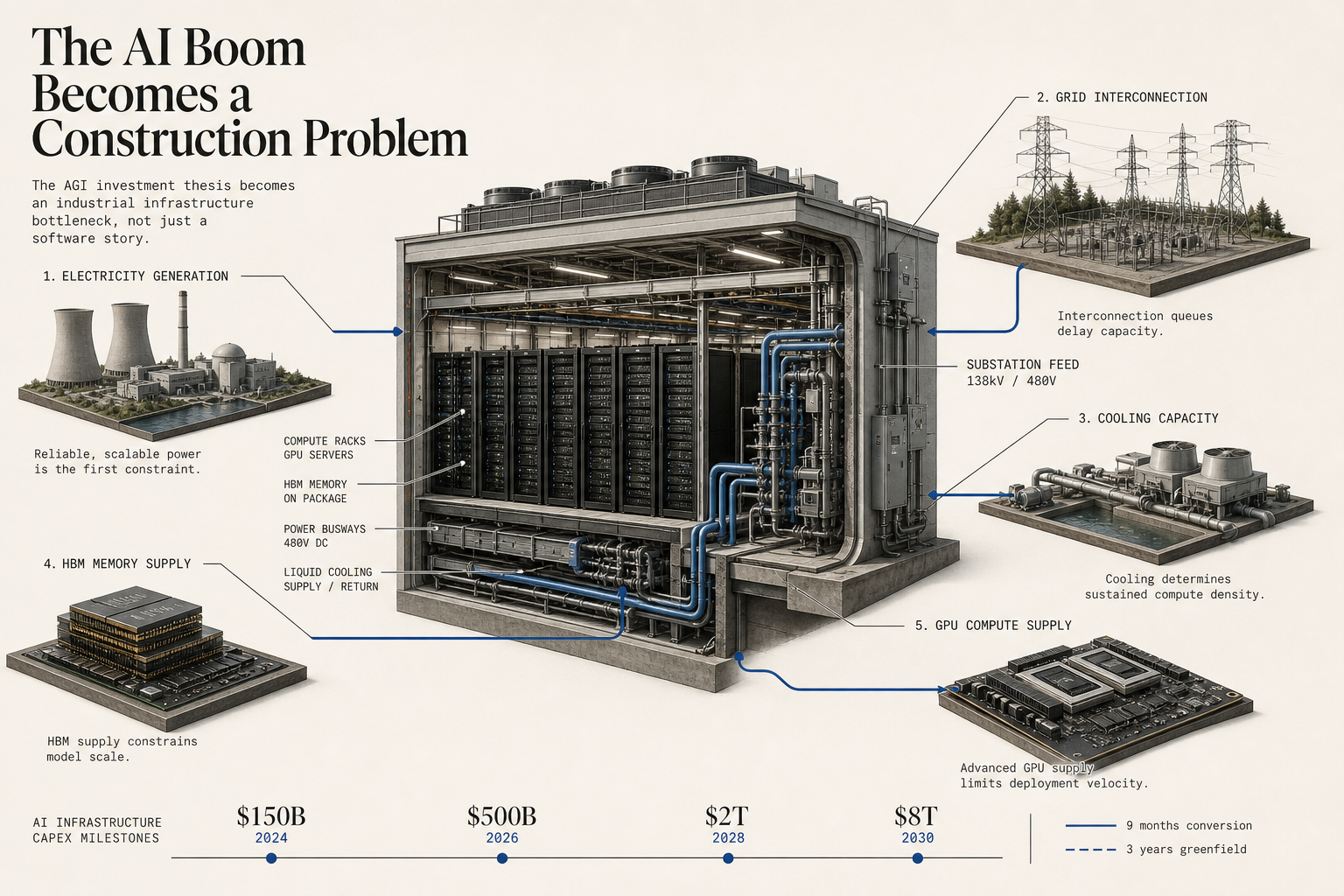
This was the eschatological architecture. The investment architecture followed from it. If the race to AGI was fundamentally an industrial mobilization, the real bottleneck was not algorithmic insight but physical capacity: electricity, cooling, land, memory, and compute. Aschenbrenner projected capital spending for AI infrastructure at $150 billion in 2024, $500 billion by 2026, $2 trillion by 2028, and $8 trillion by 2030, eventually consuming the entirety of US electricity generation. [13] Whoever controlled the picks and shovels of that buildout would capture the defining economic opportunity of the decade.
Building the Fund
Aschenbrenner began raising capital almost immediately after the essay's publication. The fund, incorporated on May 6, 2024, as Situational Awareness Partners LP in Delaware, filed its first Form D in September 2024 and deployed its first capital on November 1, 2024. [15] The seed round of approximately $225 million came from Patrick and John Collison, the co-founders of Stripe; Nat Friedman, the former GitHub chief executive; Daniel Gross, an investor and former Apple and Y Combinator figure; and Graham Duncan of East Rock Capital, a $3.7 billion multi-family office that Duncan had co-founded with a philosophy he described as "Talent Is the Best Asset Class." [16] [17] Jane Street, the quantitative trading firm, later joined as an investor, an unusual commitment given the firm's rarity in backing external managers. [16] [18]
For director of research, Aschenbrenner recruited Carl Shulman, an AI forecaster and governance researcher with deep ties to the AI safety community and prior experience at Clarium Capital, Peter Thiel's global macro hedge fund. [19] [20] The ownership structure registered with the SEC reflected a close partnership: Aschenbrenner held 50 to 75 percent, Shulman 25 to 50 percent, and Nicholas Gross-Whitaker, the chief operating officer, 5 to 10 percent. [21]
The fund's investment thesis was, in the Fortune profile writer Sharon Goldman's phrase, "the essay made literal." [14] Where mainstream AI investing concentrated in NVIDIA, Microsoft, Amazon, Google, and Meta, which were already richly valued, Situational Awareness sought the less-obvious infrastructure layer: power generation companies, data center operators, memory chip makers, and Bitcoin miners already in possession of power contracts, substations, cooling systems, and land that could be repurposed as AI compute facilities. Aschenbrenner noted that converting an existing Bitcoin mining facility to AI infrastructure took roughly nine months, versus three years for a greenfield data center. [22]
The fund's Q1 2026 Form 13F disclosed $13.68 billion in notional exposure across 42 positions. [23] Long positions of consequence included CoreWeave at approximately $1.21 billion, Bloom Energy at $875 million to $911 million, Intel call options at $746.8 million, Lumentum at $478.6 million, Core Scientific at $418.7 million, IREN at $328.6 million, SanDisk at $250.2 million, and Applied Digital at $278 million, alongside bitcoin mining operators including Riot Platforms, CleanSpark, and Cipher Mining. [24] [16] The fund also held, outside the 13F reporting requirements, an approximately $5 billion stake in Anthropic, acquired during that company's February 2025 funding round when Anthropic was valued at around $60 billion. [16]
Approximately 62 percent of the portfolio by notional exposure consisted not of outright long positions but of put options against semiconductor and technology names: $2.04 billion against the VanEck Semiconductor ETF, $1.57 billion against NVIDIA, $1.1 billion against Oracle, $1 billion against Broadcom, $969 million against AMD, $535 million against TSMC, and $494 million against ASML, among others. [25] [26] These were structural hedges, bets that the dominant chipmakers would underperform while the infrastructure layer outperformed, an expression of the core thesis in derivative form.
Three prime brokers, Goldman Sachs, JPMorgan Chase, and Bank of America, provided financing against the public equity positions at approximately four times leverage. [16] That ratio is the hinge on which this entire story turns.
What Four Times Leverage Actually Means
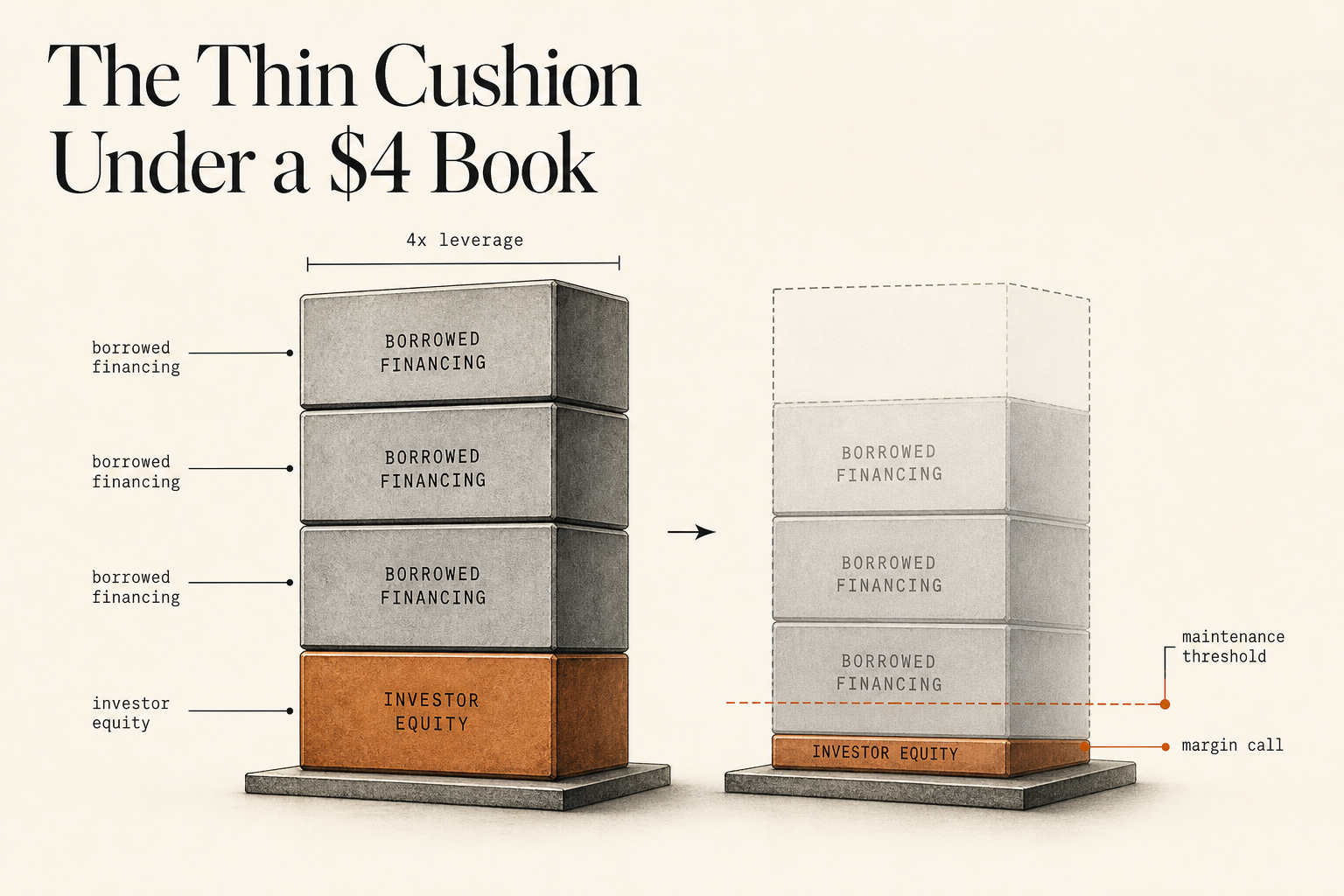
Leverage is a word used loosely in financial journalism, so the mechanics deserve precise treatment. When a fund operates at four times leverage, it controls four dollars of assets for every one dollar of investor capital it actually possesses. A fund with $10 billion of investor capital at four times leverage controls $40 billion of positions; the additional $30 billion is borrowed from prime brokers against the portfolio as collateral. [27]
The equity cushion, that one dollar in four, is the margin. Prime brokers require that cushion to remain above a maintenance threshold, typically 20 to 30 percent of total assets. They mark the portfolio to market every trading day. If positions fall and the equity cushion drops below the maintenance threshold, the prime broker issues a margin call: post additional collateral within hours, or the broker begins liquidating positions to recover its loans. [28] [29]
The mathematics of four times leverage are unforgiving. If the underlying portfolio falls by 25 percent, the investor's entire equity cushion is gone; the remaining value belongs to the prime brokers. When Situational Awareness's AI infrastructure holdings fell 35 to 47 percent from their peaks in July 2026, the fund's prime brokers did not need to wait for a 25 percent threshold. [16] The margin calls arrived while positions were still falling.
The structural problem is that margin calls are procyclical. They arrive precisely when raising cash is hardest, when bid-ask spreads have widened, buyers have retreated, and every other leveraged participant is selling simultaneously. The prime broker's right to liquidate is contractual and immediate. The fund cannot negotiate timing. [30] This dynamic, forced selling into a falling market that itself depresses prices further, triggering fresh margin calls, was what Long-Term Capital Management experienced in August and September 1998, when Russia's debt default caused every position the fund held to move against it simultaneously. LTCM lost $1.85 billion in August 1998 alone, 44 percent of remaining capital. [31] The Federal Reserve organized a $3.625 billion rescue by fourteen financial institutions to prevent cascading defaults across the global financial system. [32]
Aschenbrenner himself, in his letter to investors after the collapse, reached for the same metaphor. He described what had happened as "essentially similar to a bank run: vulnerability begetting more vulnerability." [33] The phrase captured something real. As it became known in the market that a large leveraged fund was under margin pressure in exactly the stocks it was known to own, sophisticated traders began positioning against those stocks, accelerating the very decline that was generating the margin calls. S3 Partners, a financial analytics firm, later concluded that Situational Awareness was not a deliberate target of predatory short-sellers; rather, the losses resulted from "highly concentrated positions in crowded trades." [34] The distinction mattered less than the mechanism: concentration plus leverage plus a falling market produced a feedback loop with no natural bottom.
The Rise: 439 Percent
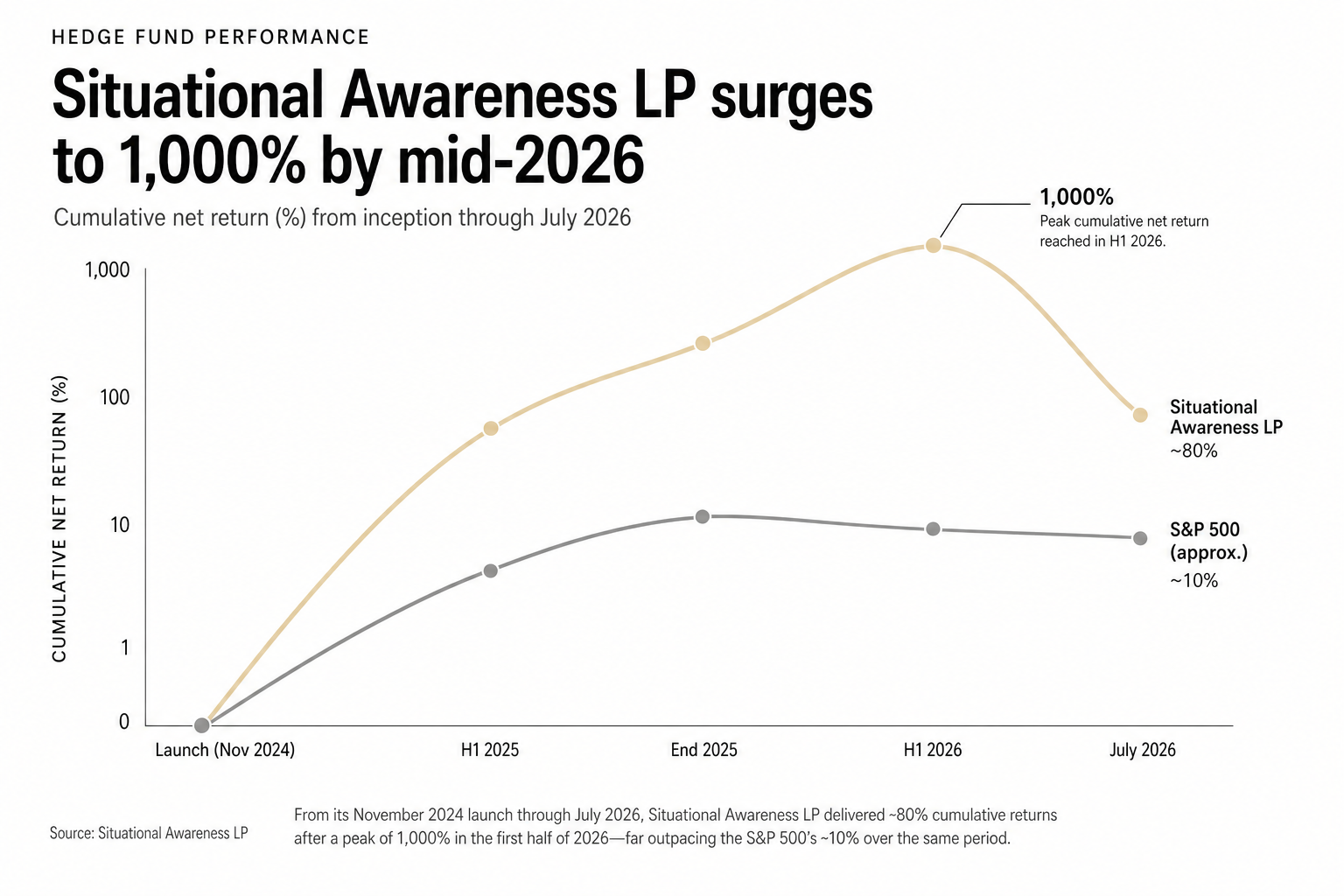
Before the collapse, the returns were extraordinary. The fund delivered 47 percent after fees in the first half of 2025, against approximately 6 percent for the S&P 500. [14] By October 2025, assets under management had reached $1.5 billion. [14] By the end of 2025, disclosed US equity exposure had grown to $5.5 billion, a roughly twenty-two-fold increase in twelve months. [35] By March 2026, regulatory assets under management registered with the SEC had reached $9.278 billion. [15] By early July 2026, the fund stood at approximately $45 billion, a 200-fold increase from its $225 million seed round in less than two years.
In the first half of 2026 alone, the fund generated a 439 percent net return, as documented in Aschenbrenner's July 24, 2026 letter to investors, reviewed by the Financial Times. [16] [5] Cumulative returns since inception through mid-2026 exceeded 1,000 percent after fees. [16]
The stocks driving these gains had genuine fundamental stories. Bloom Energy, which manufactures solid oxide fuel cells deployable on-site at data centers without waiting for grid interconnection, grew revenue 37.3 percent in 2025 to $2.024 billion and announced a $5 billion financing partnership with Brookfield for AI infrastructure projects in August 2025. [36] CoreWeave, a pure-play AI cloud capacity provider, reported $2.078 billion in revenue for Q2 2026 alone, with a $99.4 billion revenue backlog. [37] SanDisk's non-GAAP gross margins reached 78.4 percent on the strength of NAND flash memory shortages. [38] SK Hynix, with all of its HBM memory production for 2026 already sold out and a market capitalization approaching $1 trillion, represented the memory supply chain indispensable to every major AI training cluster. [39]
The fund's performance, charted against the S&P 500, illustrated the gap between what the infrastructure thesis produced and what conventional equity markets delivered during the AI buildout.
Graham Duncan, who had invested personally in the fund, told Fortune he was struck by Aschenbrenner's "combination of insider perspective and bold investment strategy," comparing him to Michael Burry, who identified the subprime collapse years before it occurred. [14] The comparison was apt in ways Duncan may not have fully intended. Burry, too, was right about the thesis and nearly destroyed by the timing.
The Cascade
The trigger arrived on July 10, 2026, when SK Hynix listed American Depositary Receipts on the NASDAQ, raising approximately $26.5 billion in what was reported as the largest-ever US listing by a foreign company. [40] Situational Awareness held an approximately $7 billion cornerstone indication in the listing. [16] The listing, far from being the catalyst for continued gains, precipitated a sharp unwind of leveraged positions in Korean technology equities. SK Hynix's US-listed shares fell approximately 47 percent from their June peak in the weeks that followed. [16]
The damage propagated across the entire AI infrastructure complex through the rest of July. By the month's end, Nebius Group shares had fallen 43 percent, CoreWeave 36 percent, SanDisk more than 50 percent. [16] [41] The Philadelphia Semiconductor Index fell 28.6 percent from its June 22 peak. [16] Credit-default-swap costs on AI infrastructure borrowers surged as investors questioned whether the capital expenditure boom could sustain itself at the rates projected. [16] The macro narrative, which had for eighteen months been unambiguously favorable for the infrastructure thesis, cracked.
The fund's hedge book offered no protection. The put positions against software names, including Adobe, were constructed on the assumption that software companies would underperform hardware and infrastructure beneficiaries. In July, software rallied. The pair trade failed on both legs simultaneously: long infrastructure falling, short software rising. [42] [41]
On July 24, six days before the forced sale, Aschenbrenner sent investors a letter describing July's AI stock selloff as "some of the most attractive opportunities since early 2025." The letter's postscript invited fresh capital commitments by August 1: "At times we call out opportunities that seem like a particularly good time to add funds, if you have been waiting for one." [16] [41] The capital did not arrive.
Aschenbrenner simultaneously pursued every alternative. He approached Sequoia Capital and Greenoaks Capital about purchasing approximately $3.5 billion of the Anthropic stake to raise emergency cash. Those transactions fell apart. [2] He reached out to existing investors and lenders, offering certain limited partners the option to take direct ownership of portfolio assets rather than waiting for standard capital call procedures. [43] [44] Millennium Management and Jane Street, both early supporters of the fund, evaluated the portfolio and declined to purchase it. [16]
By July 30, Goldman Sachs, JPMorgan Chase, and Bank of America had issued margin calls requiring additional collateral or immediate liquidation. [16] Goldman Sachs's own prime brokerage data showed that hedge fund leverage had surged to record levels in 2026, with the cumulative buildup during the first five months being "the largest cumulative increase on record since 2016," and approximately 16 percent of Goldman's prime brokerage book was directly exposed to AI memory stocks. [45] The prime brokers were not exceptional in their caution. They were doing precisely what prime brokerage agreements require.
The solution to an emergency liquidation of $16 billion in illiquid, price-sensitive positions is not to sell stock by stock. Open-market liquidation at that scale would have front-run itself, each sale depressing the prices of the next, in a process familiar from every leveraged fund collapse in modern financial history. The cleaner solution, if available, is a block transaction with a single institutional buyer capable of absorbing the entire book and managing its own unwind methodically. [46]
Ken Griffin's Citadel was that buyer. The deal was assembled within 24 hours, closing before US markets opened on July 30. [23] Goldman Sachs and JPMorgan Chase, serving simultaneously as prime brokers to the seller and advisers to the transaction, helped arrange the transfer. [47] The exact purchase price and discount were not publicly disclosed by either party. Business Insider reported a discount of approximately 10 percent below market value. [48] Citadel, with approximately $71 billion in assets under management, had the capital and the analytical infrastructure to move when others had retreated. [23]
The pattern was not new. In September 2006, Citadel and JPMorgan had jointly acquired the energy portfolio of Amaranth Advisors after Amaranth lost approximately $6.6 billion on concentrated natural gas bets. The portfolio transferred at a $2.15 billion discount to the previous day's mark-to-market value; Citadel ultimately received a net payment of approximately $1.425 billion for taking on the positions, then managed an orderly unwind through October 2026 as natural gas spreads recovered. [49] In July 2007, Citadel assembled a team that made an offer to purchase Sowood Capital Management's distressed credit portfolio at 3:30 in the morning, while competitors had stopped working. Sowood had lost more than 50 percent in a single month. Citadel "made huge profits as the markets recovered." [50] [51] The Situational Awareness transaction was a third chapter in the same playbook.
What happened after the block sale confirmed the thesis, at least for Citadel. Once it was known that the forced seller was out of the market, the AI infrastructure stocks that Aschenbrenner had been compelled to sell bounced sharply. Bloom Energy, Nebius, IREN, SanDisk, and CoreWeave all posted large gains on July 30. [46] Citadel's flagship Wellington multistrategy fund returned 5.9 percent in July 2026, its best monthly performance since 2022. Its tactical fund and equities fund both had their best month ever. [52]
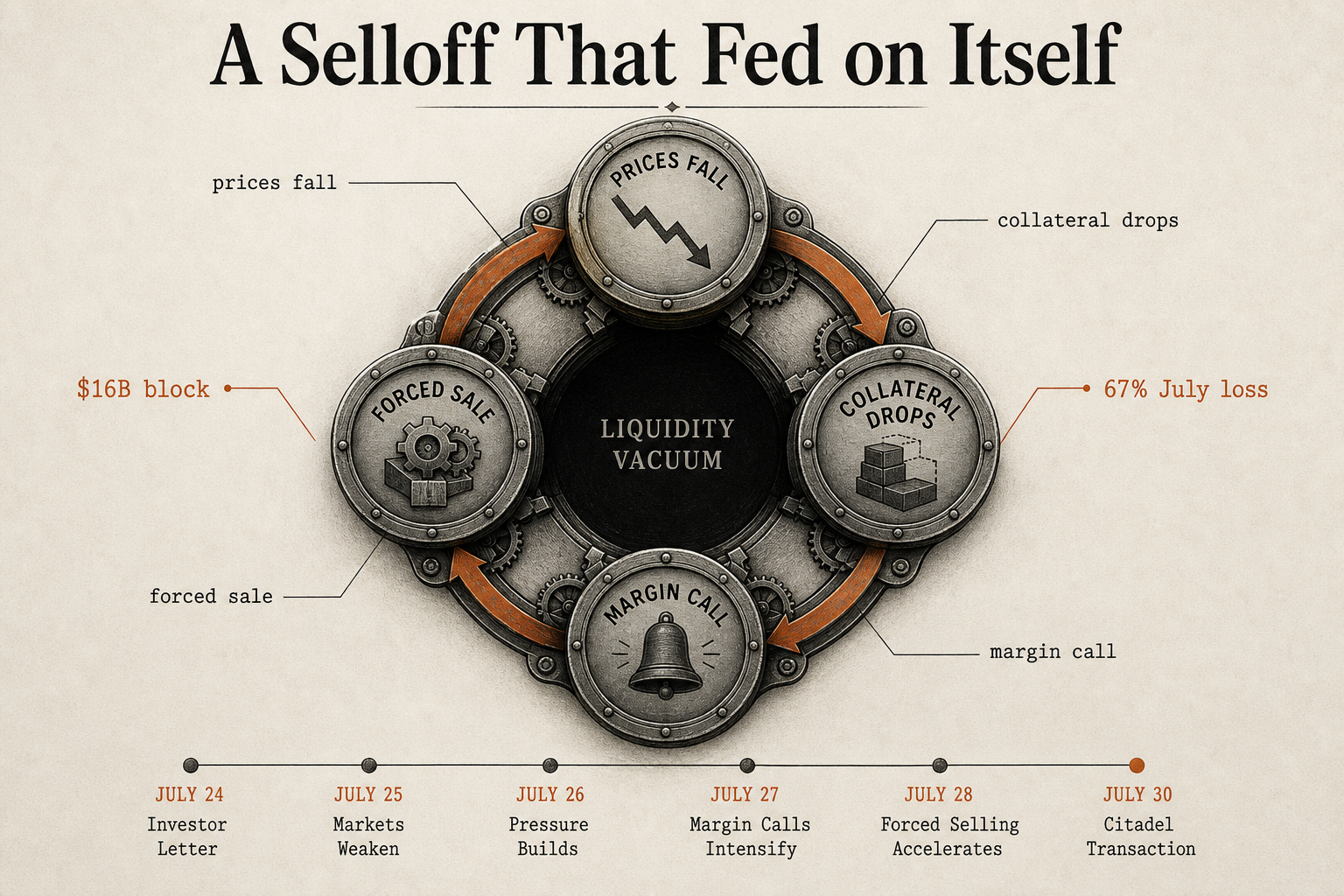
Six Days
The six days between the July 24 investor letter and the July 30 Citadel transaction reveal the full sequence of what happens when a leveraged fund exhausts its alternatives.
Aschenbrenner pursued every possible route before surrendering the portfolio. The fund held discussions with lenders about expanding credit facilities. It explored selling selected positions directly to individual investors. It approached Millennium Management, one of the world's largest and most sophisticated hedge fund operators, which evaluated the positions and declined to purchase them. Jane Street, one of the fund's own original seed investors, also evaluated the portfolio and declined. [16]
One reported sequence, confirmed in a single source and therefore presented with appropriate caution, describes Aschenbrenner coming close to an agreement on July 29 with a consortium led by Greenoaks Capital and Sequoia Capital for $3.5 billion against the fund's Anthropic stake. He reportedly withdrew from that arrangement before morning and proceeded instead to the Citadel transaction. [53] This sequence, if accurate, reflects the genuine difficulty of arranging emergency private financing on a timeline measured in hours.
By July 30, margin calls had arrived from all three prime brokers. Goldman Sachs, JPMorgan Chase, and Bank of America exercised their contractual rights to demand additional collateral. [54] [16] There was no additional collateral to provide. The fund's only remaining option was the sale of the public portfolio as a unit to a single buyer capable of absorbing it before markets opened on Thursday morning.
The buyer was Citadel.
"We let you down this month," he opened.
The Buyer, and Why It Was Always Going to Be Citadel
Ken Griffin's Citadel has spent three decades developing a specific capability that its competitors either cannot replicate or choose not to: the ability to evaluate, price, and acquire an entire distressed portfolio under conditions of extreme time pressure. The pattern is documented and deliberate. [55] [56]
In September 2006, when Amaranth Advisors lost approximately $6 billion on concentrated natural gas bets, representing 65 percent of its assets, Citadel and JPMorgan Chase jointly acquired the energy portfolio and division at a steep discount. The Amaranth transaction, by one account, produced returns equivalent to "the kind of high-single digit return that the hedge fund would usually make over a six-month period" in compressed time. [57] In July 2007, when Sowood Capital Management lost 50 percent of its capital in the early stages of the credit dislocation, its founder Jeffrey Larson called Citadel on a Sunday morning. By 6 a.m. Monday, before markets opened, Citadel had acquired most of Sowood's assets, assembled a team of 50 analysts working through the night to assess the trading book. [58] [59] "There will be nothing to pick up in the morning," Griffin told a competing bidder who had proposed resuming negotiations at sunrise. [57]
The Situational Awareness acquisition followed the identical logic. Citadel acquired approximately $16 billion in public equity holdings at a discount exceeding 10 percent to market value, completing the transaction before Thursday's opening bell. [52] Aschenbrenner specifically chose to conduct the sale as a single-buyer block deal rather than a piecemeal open-market liquidation, a deliberate decision. Open-market selling of a concentrated, publicly known book would have allowed other traders to front-run each individual position unwind, depressing prices further with each successive trade. A block sale to a single sophisticated buyer, priced at a negotiated discount, removed that dynamic entirely. [16]
The market's reaction was immediate and instructive. Within hours of the announcement that Citadel had absorbed the portfolio and that Situational Awareness was no longer a forced seller in the market, the stocks that had been in free fall reversed sharply. SK Hynix rose approximately 17 percent. SanDisk climbed around 24 percent. Micron advanced roughly 18 percent. CoreWeave gained more than 21 percent. Nebius jumped over 27 percent. [16] [60] This recovery pattern, which mirrored what happened after both the Amaranth and Sowood acquisitions, confirmed what had been suspected but not provable during the decline: the selling pressure had been mechanical, not fundamental. The companies themselves had not deteriorated. The financing structure around the fund that owned them had.
Citadel's performance for July 2026 quantifies what crisis-buying at scale produces. The Wellington flagship fund gained 5.9 percent in July, its best monthly performance since 2022. The Tactical Trading fund gained 11.1 percent, its best month on record. The Equities fund gained 14.2 percent, also its best month on record. [52] Citadel managed approximately $71 billion in assets at the time of the transaction, generating more trading revenue in 2025 than Goldman Sachs. [52] [16] The Situational Awareness acquisition was executed at a scale Citadel could absorb without distress and priced at a level that positioned it to benefit immediately from the removal of the forced seller.
The transaction was not a rescue in any charitable sense. It was a purchase at a discount by a buyer who understood precisely what the underlying assets were worth once the mechanical selling pressure was gone.
What Survived, and Why
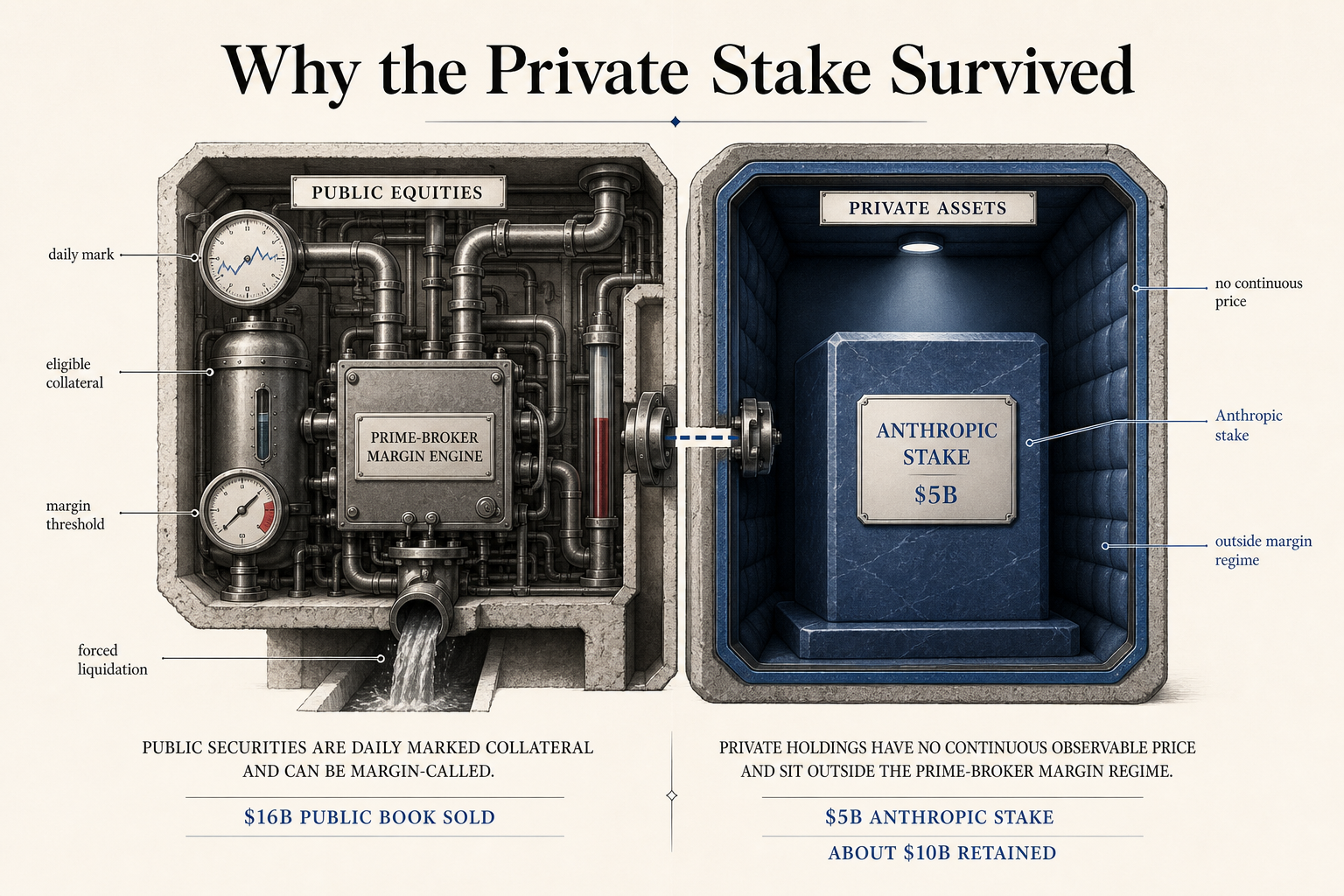
Situational Awareness LP did not dissolve after July 30. The fund retained approximately $10 billion in assets, almost entirely composed of private company holdings that had been invisible to the margin call cascade. [54] [16] [61]
The most significant of these was a stake in Anthropic, the AI safety company, valued at approximately $5 billion. The position had been acquired in February 2025 when Anthropic was valued at approximately $60 billion. [16] By May 2026, Anthropic had completed a Series H financing round at a valuation of $965 billion. [61] An IPO was expected as early as October 2026. The firm's spokesman denied reports that the Anthropic stake was being marketed for sale. [16] [61] The fund also retained positions in MatX, a chipmaker startup, and Fluidstack, an AI data center company that had been in discussions to raise capital at an $18 billion valuation as recently as April 2026. [61]
The structural reason these positions survived requires a precise explanation, because it is not merely that private assets are harder to sell. It is that private assets are constitutionally outside the margin call regime.
Prime brokers extend leveraged credit against public securities because those securities have observable market prices, marked to market every trading day. The collateral value of a public stock position is unambiguous at 4:00 p.m. each afternoon. When that price falls, the collateral shortfall is immediately calculable, and the margin call mechanism activates automatically. A private company stake has no such daily market price. Its value cannot be continuously re-marked against a margin threshold because no continuous observable price exists. Prime brokers do not lend against private holdings for this precise reason. [16] [61]
This structural distinction means that a fund holding both public and private assets will always experience leverage-driven crises as a selective disaster: the public book becomes a forced sale, and the private holdings remain untouched. The result, in Situational Awareness's case, was that Aschenbrenner retained the position with the highest-conviction, longest-duration thesis, the Anthropic stake he had built at a time when Anthropic was valued at $60 billion, while surrendering the positions subject to daily mark-to-market discipline at a discount to a buyer who immediately profited from the rebound.
The fund paradox produced by this structure is arithmetically striking. Despite losing 67 percent in July, Situational Awareness remained up approximately 80 percent year-to-date in 2026. [62] [63] This figure reflects the fact that Anthropic had appreciated roughly 620 percent year-to-date, contributing approximately positive 155 percent to overall portfolio returns. The forced liquidation of the public portfolio, which had accounted for roughly three-quarters of total holdings, contributed approximately negative 75 percent. The net was positive 80 percent for the year despite a historically severe month. [62]
The Recapitalization and What It Signals
The recapitalization that followed tells a different story than the collapse itself. By August 5 to 6, 2026, Situational Awareness had closed a $400 million investment in an undisclosed private company backed by Sequoia Capital. [64] [65] Sequoia partner Alfred Lin confirmed on Bloomberg television that Aschenbrenner "did just wire $400 million to a company that we invested in." The fund had already committed $100 million to the same company in July prior to the crisis, bringing total committed capital to $500 million. [64] The specific identity of the recipient remained undisclosed in public reporting.
The investors who put money into Situational Awareness both before and after the crisis are worth examining carefully. Named investors in the fund include Greenoaks Capital founder Neil Mehta, XN Foundation founder Gaurav Kapadia, Tiger Global Management's former head of public equities Feroz Dewan, and D1 Capital Partners founder Dan Sundheim. [64] [66] These are among the more sophisticated allocators in global technology and growth equity, practitioners who have navigated multiple market cycles in high-growth technology investment. None of them, based on available reporting, appear to have redeemed following the July collapse.
The explanation offered by those familiar with the fund's investor base is structural. Situational Awareness drew primarily from wealthy individuals and family offices rather than large institutional allocators. [67] Institutional capital, managed by fiduciaries operating under formal investment policy statements and subject to board-level governance, tends to produce rapid and mandatory redemption pressure following severe drawdowns. Family offices and high-net-worth individuals operate with considerably more discretion. They can evaluate whether the drawdown was thesis-driven or mechanics-driven, and behave accordingly.
The distinction matters enormously in determining what the recapitalization actually signals about LP appetite for the AI trade. If the people closest to the collapse, those who lived through the 67 percent monthly loss and received the July 31 letter in real time, did not flee, that is a signal. It suggests that sophisticated capital remained persuaded that Aschenbrenner's structural argument about AI infrastructure was correct, and that what had failed was not the idea but the financing vehicle around it.
The broader investor behavior in late July 2026 supports this interpretation. Even as Situational Awareness was conducting its emergency negotiations, Greenoaks Capital participated in a $180 million Series A for Glow, an AI-native endpoint security company, alongside Sequoia Capital, Redpoint Ventures, and Index Ventures. [68] Tiger Global led a $180 million Series B for Augustus, an AI-era clearing bank. [69] These are not the investment patterns of institutional actors who have concluded that the AI infrastructure thesis has been invalidated. They are the investment patterns of institutions that have concluded that the vehicle matters more than ever.
The Goldman Sachs mid-2026 analysis of 1,059 hedge funds managing $4.6 trillion in gross equity positions found that semiconductor exposure had reached approximately 10 percent of hedge fund portfolios, the highest level on record. [70] [71] Hedge funds lifted their net allocation to the information technology sector by 853 basis points in the second quarter of 2026, the largest quarterly increase to the sector on record. [71] The typical hedge fund held 72 percent of its long portfolio in its top ten positions. Goldman Sachs itself disclosed that as of June 30, 2026, approximately 16 percent of its prime brokerage exposure was directly exposed to AI memory-related names. [72] The AI infrastructure trade was not a niche bet. It was the consensus position of the most sophisticated institutional capital in the world.
The Situational Awareness collapse did not change that consensus. It refined it. The lesson that sophisticated capital appeared to absorb from July 2026 was not that the AI infrastructure thesis was wrong but that concentrated, leveraged exposure to daily-marked public equities in a thematic trade produces a specific and recurring vulnerability. When the trade is crowded, as it clearly was by mid-2026, the forced selling of one large participant creates cascading pressure across all participants simultaneously, because every other fund owning the same names faces the same margin-call arithmetic when prices drop.
Morgan Stanley's mid-year 2026 outlook had identified this vulnerability months before it materialized, noting that "sharp reversals in AI and technology positioning have triggered crowded unwinds and highlighted concentration risk." [73] The lesson was theoretically available. The July experience made it empirically unavoidable.
The Letter
Aschenbrenner wrote to his limited partners on July 31. The letter, portions of which were reported by Business Insider, is a document that does not dissemble. [33] [74]
"We let you down this month," he opened. He continued: "We came closer to permanent capital impairment than is acceptable to us. While we ultimately found a solution that protected the fund and you as investors, our intention in running the fund is to never find ourselves in such a position in the first place."
The core structural lesson he drew was stated plainly: "Our fund must always be structured such that we can take a loss and fight another day." He described the bank-run dynamic with mechanical accuracy. He acknowledged that after the forced deleveraging, "We currently manage a fully-paid-for public book (long stock and long fully-paid-for options, with no margin/liquidation risk)." He took full responsibility. He described the month's events as "very expensive scars" that would become "invaluable lessons." He noted that nearly all of his personal wealth remained invested in the fund alongside his limited partners.
The next day, August 1, several of the stocks Aschenbrenner had been forced to sell bounced sharply in the morning session. SanDisk rose 25.99 percent. CoreWeave rose 21.51 percent. [53] The thesis had been right. The financing had been wrong.
The Archegos Reference Point
The Situational Awareness collapse has been described as the largest leveraged unwind on Wall Street since Archegos Capital Management in March 2021. [75] The comparison is instructive partly because of the parallels but more because of the differences.
Archegos, the family office run by Bill Hwang, had accumulated an estimated $160 billion in notional exposure on approximately $10 billion in underlying capital, representing leverage of approximately 16 times. [76] Critically, Archegos conducted this accumulation through total return swaps rather than direct stock ownership, which meant that no single prime broker had visibility into the aggregate leverage, and the positions were invisible to public disclosure through 13F filings. When the collapse came in March 2021, Goldman Sachs, Morgan Stanley, Deutsche Bank, Credit Suisse, Nomura, UBS, Mitsubishi UFJ, and Wells Fargo were all simultaneously exposed to the same client without knowing it. Total reported losses across banks exceeded $10 billion. Credit Suisse alone lost $5.5 billion. [77] [76]
Situational Awareness was different in critical ways. The fund's leverage was four times, not sixteen. Its holdings were public equities disclosed in quarterly 13F filings, not hidden behind derivative structures. Its prime broker relationships were three banks, not eight, each with full visibility into the fund's public book. The failure of risk management was at the fund level, not the prime broker level. And when the resolution came, it did not inflict losses on the banks that had financed the portfolio. It simply forced the portfolio's liquidation at a discount to a third-party buyer.
The Archegos comparison is useful in understanding the mechanics of leverage-driven cascade. But the Situational Awareness collapse was cleaner, more visible, and ultimately more quickly resolved precisely because it lacked the opacity and counterparty complexity that made Archegos so catastrophic for the banking system.
The Shape of What Comes Next
Situational Awareness LP emerged from July 2026 as a fundamentally different entity from the one that entered it. The transformation was not chosen. It was imposed by the mathematics of leverage and the contractual rights of prime brokers. The fund that had been a leveraged long-short public equity vehicle is now, in Aschenbrenner's own framing, a "fully-paid-for public book" alongside a concentrated private portfolio anchored by a multibillion-dollar Anthropic position. [33] The structural vulnerability that destroyed the public book has been eliminated, not because the fund was restructured in any formal sense, but because there is no margin left to call.
The Anthropic stake represents the clearest expression of the thesis in its purest, most structurally durable form. Acquired at a $60 billion valuation in February 2025, marked at a $5 billion contribution to fund NAV in July 2026, and anticipating an IPO at a valuation that would dwarf both those figures, the Anthropic position is the bet that cannot be margin-called, cannot be front-run by informed sellers, and cannot be forced to liquidate at the worst possible moment. [16] [61] It is, in a structural sense, the right asset to have held all along. The public portfolio generated the returns that made the fund famous. The private portfolio survived the mechanism that made it famous.
What the recapitalization investors are buying, when they put $400 million into a Sequoia-backed company through Situational Awareness in early August 2026, is not just the specific private company receiving the capital. They are buying a bet that Leopold Aschenbrenner's original thesis about the decade ahead was correct, that the AI infrastructure build-out will continue, and that the fund manager who identified this opportunity before nearly anyone else will remain positioned to capture it, this time without the financing structure that nearly ended his fund before the decade was half over. [64] [65]
Aschenbrenner closed his July 31 letter with a commitment that reads less like corporate communications and more like something personally meant: "My core promise to you is that we will not waste the opportunity to learn from these events." [33]
The scars are real, and they were expensive. The question of whether they become lessons rather than epitaphs will be answered somewhere in the decade ahead, in the data centers being built and the chips being fabricated and the power plants being connected to grids that did not exist two years ago. The thesis has not changed. Only the structure has.
- The mathematics of four times leverage are unforgiving.
- The fund's hedge book offered no protection.
- The transaction was not a rescue in any charitable sense.
- The lesson that sophisticated capital appeared to absorb from July 2026 was not that the AI infrastructure thesis was wrong but that concentrated, leveraged exposure to daily-marked public equities in a thematic trade produces a specific and recurring vulnerability.
Get the next issue in your inbox.
Free, weekly. One company or market, taken completely apart — every figure sourced and verified with Valyu DeepResearch.
Issue queued.
Your next cited briefing is on its way to .