Valyu Logo

AGENTS THAT ANSWER — AND RESEARCH

From instant, cited answers to deep, multi-step investigations with real deliverables.

Not every question needs the same depth

Sometimes your agent needs a fast, grounded answer. Sometimes it needs to investigate, synthesize, and produce a report you can actually use. Valyu Agents handle both — using the same search infrastructure, the same source control, and the same commitment to traceability.

Try Valyu
Deep Research API
(beta)

Analyze the legal framework governing commercial space activities. Examine the Outer Space Treaty and subsequent agreements, catalog national space laws (US Commercial Space Launch Act, Luxembourg space mining law, UAE space law), document liability frameworks for space debris and collisions, analyze property rights for space resources (asteroid mining, lunar resources), evaluate licensing requirements for launches

ExamplesClearRun⌘⏎

How Deep Research Works

1. Define the Task

Natural language input. Choose depth, sources, and outputs.

2. Investigation

Planning, searching, extraction, and synthesis — fully automated.

3. Receive Deliverables

Download files or consume structured outputs with citations.

Research that produces work-ready outputs

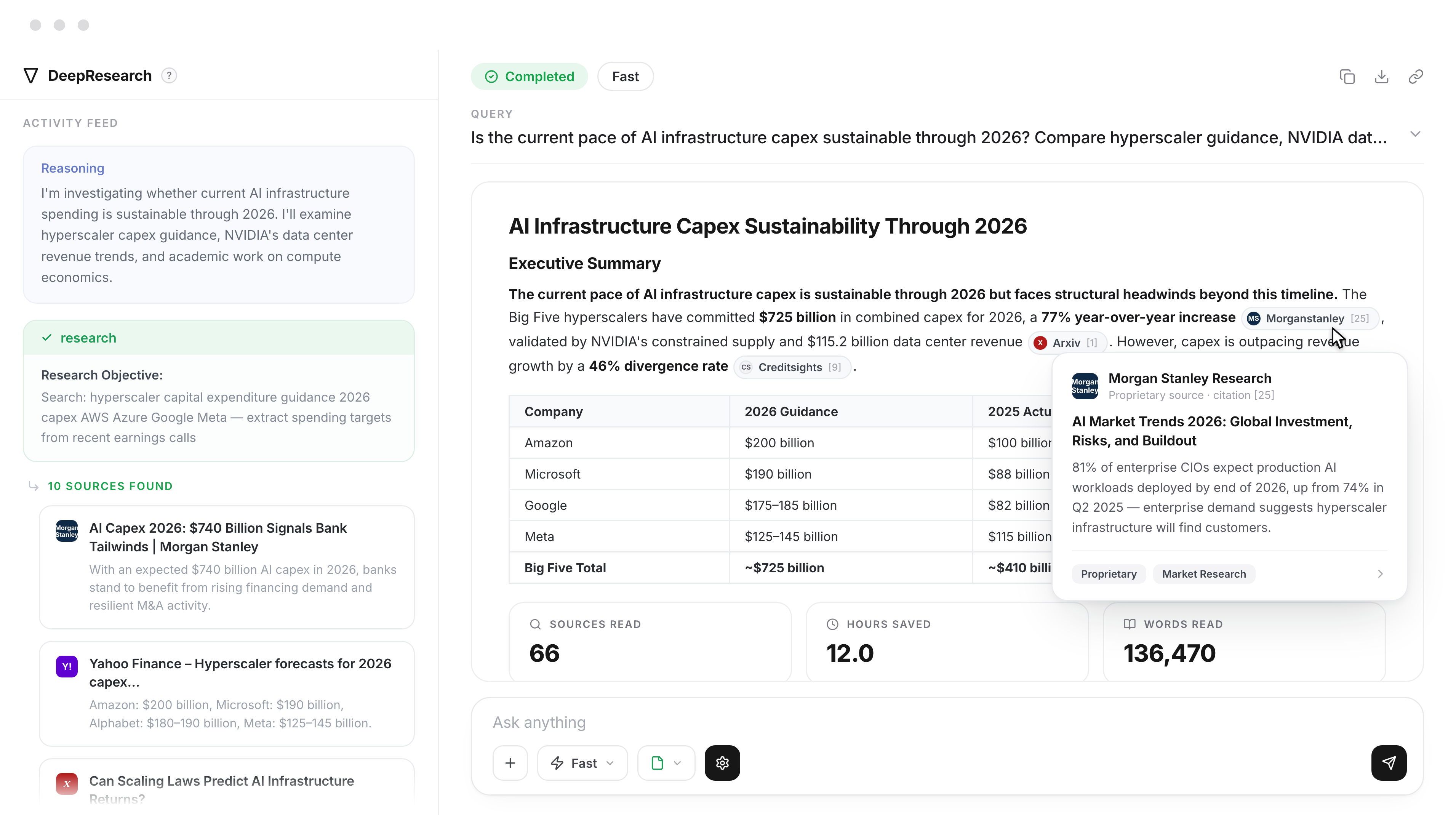
Knowledge work doesn’t stop at answers. It ends with reports, analyses, and documentation. Deep Research plans and executes multi-step investigations, synthesizes findings across sources, and generates deliverables you can use immediately — from PDFs to spreadsheets to structured data.

Source Control

Fine-grained control across web, academic, financial, and medical sources.

File Inputs

Upload PDFs, images, and documents to extend the research context.

Custom Schemas

Define exactly how results should be structured.

Full Traceability

Every insight links back to its source.

OUTPUT

mRNA Therapeutic Platforms Beyond COVID-19: Comprehensive Pipeline Analysis and Commercial Outlook

Executive Summary

The global mRNA therapeutic landscape has expanded dramatically beyond COVID-19 vaccines, with 45+ programs in development across oncology, infectious diseases, rare genetic disorders, and cardiovascular conditions Medrxiv. The therapeutic promise extends far beyond pandemic applications: personalized cancer vaccines demonstrate 49% reduction in recurrence or death in melanoma adjuvant settings Cancernetwork, RSV mRNA vaccines achieved FDA approval in 2024-2025 with 83.7% protection efficacy Cancernetwork, and Sanofi's H5N1 mRNA influenza vaccines are dosing patients as low as 0.30 mg/kg in early-phase trials Reddit Wikipedia Cancernetwork. Critical program milestones define 2026-2027 as an inflection point: Moderna's mRNA-4157/V940 (Intsmeran autogene) expects Phase 3 interim readout mid-2026 with formal data September 2026, positioning it for regulatory approval by late 2026 or early 2027 Reddit; BioNTech and Roche's BNT116 (NSCLC off-the-shelf vaccine) Nih

SOURCES (57)View All

The Promise of mRNA Cancer Vaccines: Potential Lives Saved and Economic Value in the U.S.

Sources Read

111

Words Read

236867

Hours Saved

20.7

When to Use Deep Research

01 / 04

Investment and market research

Analyze markets, companies, and trends across financial filings, news, and proprietary data — with outputs ready for decision-making.

02 / 04

Regulatory and compliance analysis

Track regulatory changes, interpret requirements, and assess impact across jurisdictions using authoritative sources.

03 / 04

Scientific literature reviews

Synthesize findings from academic papers, clinical trials, and journals into structured, citable summaries.

04 / 04

Competitive intelligence and strategy work

Map competitors, positioning, and market dynamics to inform strategic planning and execution.

DELIVERABLES

Outputs built for real workflows

npm install valyu-js
import { Valyu } from 'valyu-js';
 
const valyu = new Valyu("*********************************");
 
// Create deep research task
const response = await valyu.deepresearch.create({
input: "Analyze the competitive landscape of AI search APIs",
mode: "standard",
outputFormats: ["markdown", "pdf"]
});
 
if (!response.success) {
console.error("Error:", response.error);
} else {
console.log("Task created:", response.deepresearch_id);
 
// Wait for completion with progress updates
const result = await valyu.deepresearch.wait(
response.deepresearch_id!,
{
onProgress: (status) => {
if (status.progress) {
console.log(`Progress: ${status.progress.current_step}/${status.progress.total_steps}`);
}
}
}
);
 
console.log(result.output);
}

How Answer works

1. Ask

Send a natural language question. Add source filters if needed.

2. Retrieve + Reason

Valyu searches authoritative sources and synthesizes the findings.

3. Answer

Get clear responses with citations and underlying search results.

Search + reasoning in a single call

When you don’t need raw search results, you don’t have to manage them. Answer mode runs Valyu search, evaluates the sources, and returns a grounded response with inline citations — fast enough for real-time agent workflows.

Source Control

Restrict answers to specific datasets or domains.

Structured Responses

Define a JSON schema. Get answers in exactly the format your app needs.

Inline Citations

Every claim traces back to a source.

Fast by Default

Most answers return in under 30 seconds.

API Response
Answer

Recent meta‑analyses consistently show that immune‑checkpoint inhibition improves survival across the lung‑cancer spectrum. In the adjuvant setting for early‑stage non‑small‑cell lung cancer (NSCLC), a network meta‑analysis of 19 randomized trials reported that immune‑checkpoint inhibitor (ICI) therapy lengthened disease‑free survival (DFS) to a median of 53.47 months versus 39.49 months with chemotherapy or placebo (Nature).

In advanced disease, pooled data from randomized trials demonstrate a robust overall‑survival (OS) advantage for immunotherapy over chemotherapy. Real‑world French data showed median OS of 16.4 months with first‑line ICIs versus 11.6 months with chemotherapy (Nature). Trial‑level meta‑analyses of PD‑1/PD‑L1 plus CTLA‑4 combinations reported a 69 % reduction in the risk of progression (HR 0.69, 95 % CI 0.56–0.85) (Medrxiv). Dual‑immunotherapy plus chemotherapy further increased median OS to ≈15.8 months (Cureus).

Biomarker‑focused meta‑analyses indicate that high tumor‑mutational burden (TMB) predicts greater immunotherapy benefit (Nih). Together, these systematic reviews confirm that immunotherapy provides significant survival benefits.

Show Code SnippetsM

When to Use Answer Mode

01 / 04

Research assistants and copilots

Answer complex questions with grounded responses and traceable sources.

02 / 04

Customer support and internal Q&A

Deliver consistent, accurate answers grounded in documentation and knowledge bases.

03 / 04

Fast fact-checking with citations

Verify claims instantly with authoritative sources and inline references.

04 / 04

Real-time agent responses

Power live agents with fast, reliable answers backed by search.

SoTA across several benchmarks

DRACO is Perplexity's open expert-rubric benchmark of 100 long-form deep research tasks across 10 professional knowledge-work domains, including finance, medicine, academic research, law, and technology. Each output is graded by a per-criterion judge against a domain-expert rubric. We ran every commercially available deep research API end-to-end against the same 100 questions.

Every search and research API was tested on its highest publicly-available compute tier. Parallel (Ultra8x), You(.)com Research (exhaustive), Tavily (pro), Exa (deep-reasoning), and Perplexity Deep Research (Opus 4.6). Valyu was run on Heavy mode; we offer a higher Max tier but did not use it here, since Max is more expensive per task than the field.

Valyu DeepResearch achieved 72.7% accuracy on the DRACO long-form research benchmark, outperforming Perplexity Deep Research (70.5%), Claude Opus 4.6 (59.8%), Gemini Deep Research (59.0%), and OpenAI Deep Research o3 (52.1%), while operating at less than half the cost of the next-best system.

Integrate in seconds

from valyu import Valyu
 
valyu = Valyu(api_key="*********************************")
 
response = valyu.answer(
"your question here"
)
 
# Access the answer
print("Answer:", response.contents)
print("Sources used:")
for source in response.search_results:
print(f"- {source.title}: {source.url}")
Call to action background

Build agents withaccess to knowledge