
The Search That Never Ends
Chemists estimate that the total number of drug-like molecules that could theoretically exist is somewhere in the vicinity of ten to the sixtieth power [1]. For context, the number of atoms in the observable universe is roughly ten to the eightieth power. Every molecule ever synthesized in every laboratory on earth represents a rounding error against this backdrop. Drug hunters were not searching; they were wandering.
The traditional industry built elaborate machinery to manage this impossibility. Large pharmaceutical companies assembled legions of chemists, biologists, and clinicians, ran high-throughput screening operations that tested tens of thousands of compounds simultaneously, and moved the promising survivors through years of preclinical and clinical development. It was expensive, slow, and mercilessly wasteful. Of every ten thousand molecules that entered the funnel, roughly one ever reached a patient [2]. Only about twelve percent of drugs entering clinical trials received FDA approval [3]. A failed late-stage clinical trial consumed anywhere from eight hundred million to over a billion dollars [3].
There is a name for what happened to pharmaceutical productivity over the decades that followed: Eroom's Law. Coined by the analyst Jack Scannell and colleagues in a 2012 paper in Nature Reviews Drug Discovery, the term inverts Moore's Law to capture something alarming. While computing power doubled every eighteen months, the number of new drugs approved per billion dollars of inflation-adjusted R&D spending roughly halved every nine years. By the 2020s, the drop in productivity compared to mid-twentieth-century levels was approximately eighty-fold [4]. Research and development spending by PhRMA member companies rose from 2.7 billion dollars in 1980 to 102.3 billion dollars in 2023 [5]. Annual approvals remained roughly flat, hovering around fifty new molecular entities per year. The industry was running to stand still.
Scannell identified four interlocking causes. First, the "better than the Beatles" problem: once a drug establishes a new therapeutic benchmark, every subsequent drug must demonstrate superiority, requiring ever-larger trials to detect ever-smaller differences. Second, regulatory intensification following the Kefauver-Harris Amendments of 1962 raised the evidentiary bar substantially. Third, the industry's response to stagnation was to invest more rather than rethink the approach. Fourth, and most fundamental, the brute-force tools at hand, including animal models and in-vitro cell cultures, predicted human biology poorly. Approximately ninety-two percent of drugs that worked in animals failed in human trials [6]. The tests were measuring the wrong things.
This is the context in which artificial intelligence entered drug discovery. Not as an incremental improvement to an existing system, but as a potential challenge to the system's underlying logic.
What the Machine Learned to See
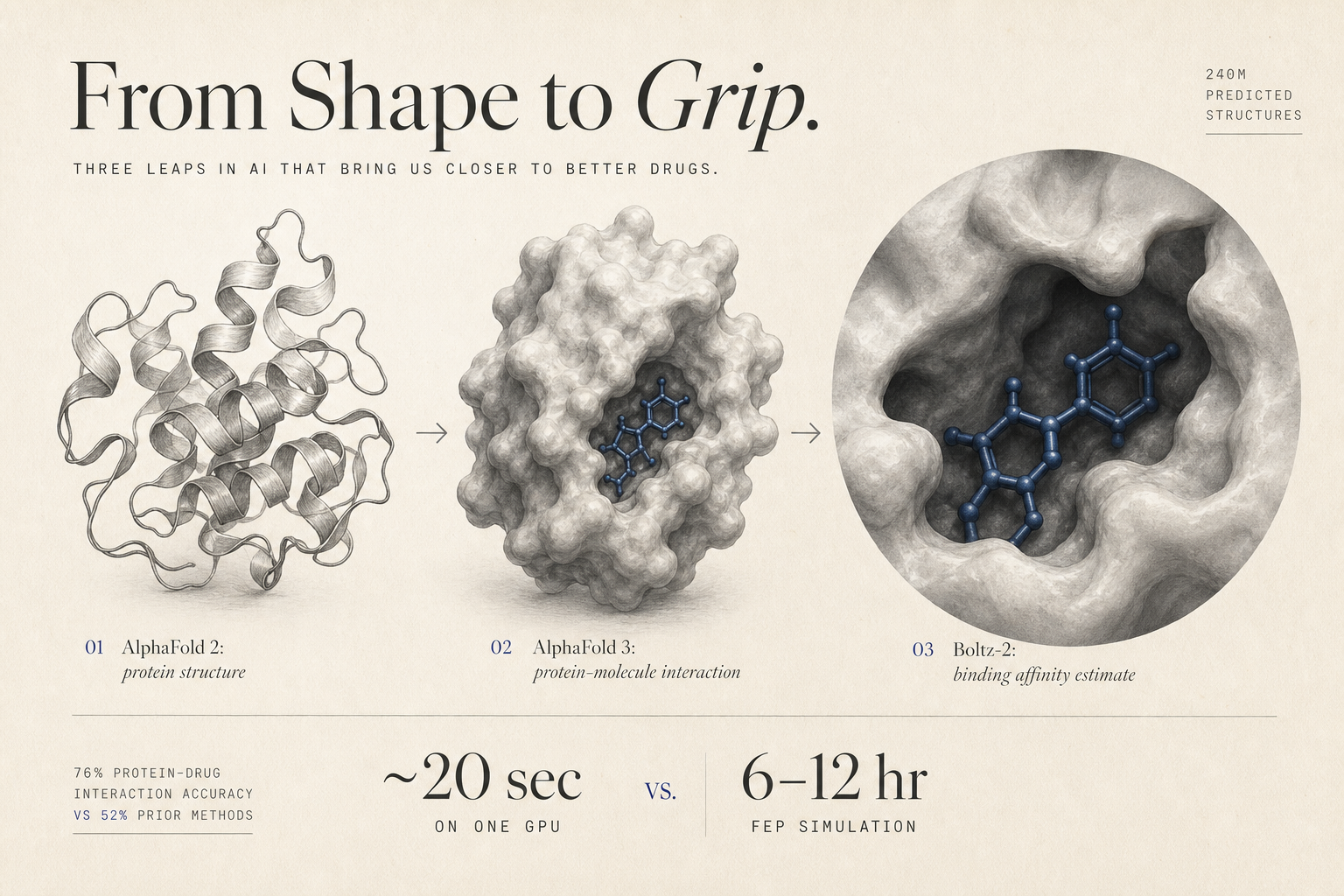
The pivotal technical development came in December 2020, when DeepMind released AlphaFold 2 and effectively solved a problem that structural biologists had wrestled with for fifty years: the protein folding challenge. Proteins are the molecular machinery of life, strings of amino acids that fold into precise three-dimensional shapes. Their shape determines their function. Drug discovery depends critically on knowing what shape a target protein takes, because only then can chemists design molecules that fit into it precisely enough to alter its behavior. Before AlphaFold, determining a protein's structure experimentally required months or years of painstaking X-ray crystallography or cryo-electron microscopy work. Only around 180,000 protein structures had been resolved experimentally by the time AlphaFold arrived. Within a year, the AlphaFold database, maintained in partnership with EMBL's European Bioinformatics Institute, contained predicted structures for 240 million proteins [7]. The tool has been cited in more than 40,000 academic papers and mentioned in over 400 successful patent applications [7].
In May 2024, Google DeepMind and its drug discovery spinout Isomorphic Labs jointly released AlphaFold 3, which expanded the model's scope in a direction directly relevant to therapeutics. Where AlphaFold 2 predicted protein shapes in isolation, AlphaFold 3 predicted how proteins interact with other molecules: small chemical compounds, DNA, RNA, antibodies [8]. It achieved at least a fifty percent improvement in predicting protein-molecule interactions, and seventy-six percent accuracy on protein-drug interactions compared to fifty-two percent for prior methods [8]. The significance for drug hunters was immediate. If a computer can accurately model how a candidate compound fits into a target protein, the central hypothesis of drug design can be tested computationally, in seconds, rather than through weeks of laboratory work.
But structure prediction, however powerful, solved only one part of the problem. Knowing that a molecule fits a protein is not the same as knowing that it works as a drug. A candidate must also be absorbed by the body, distributed to the right tissues, metabolized at a manageable rate, excreted efficiently, and not cause harm along the way. This cluster of properties, abbreviated in the industry as ADMET (Absorption, Distribution, Metabolism, Excretion, Toxicity), explains why most molecules that bind their targets still fail in trials. Machine learning models trained on millions of historical compounds can now flag ADMET liabilities computationally before a molecule is ever synthesized. One hepatotoxicity prediction model trained on over a million compounds achieved ninety-two percent accuracy [9]. The goal is to eliminate the obvious failures before spending the resources to make the molecule physically real.
Even deeper into the computation, a model called Boltz-2, released by MIT and Recursion in June 2025, accomplished something that would have seemed implausible five years earlier: it predicted binding affinity, the strength with which a drug molecule grips its target, in approximately twenty seconds on a single graphics processing unit, achieving accuracy on par with gold-standard free-energy perturbation calculations that traditionally required six to twelve hours of compute time and around a hundred dollars per simulation [10]. This is roughly a thousand-fold increase in speed, collapsing the economics of a critical bottleneck in drug design.
The Loop
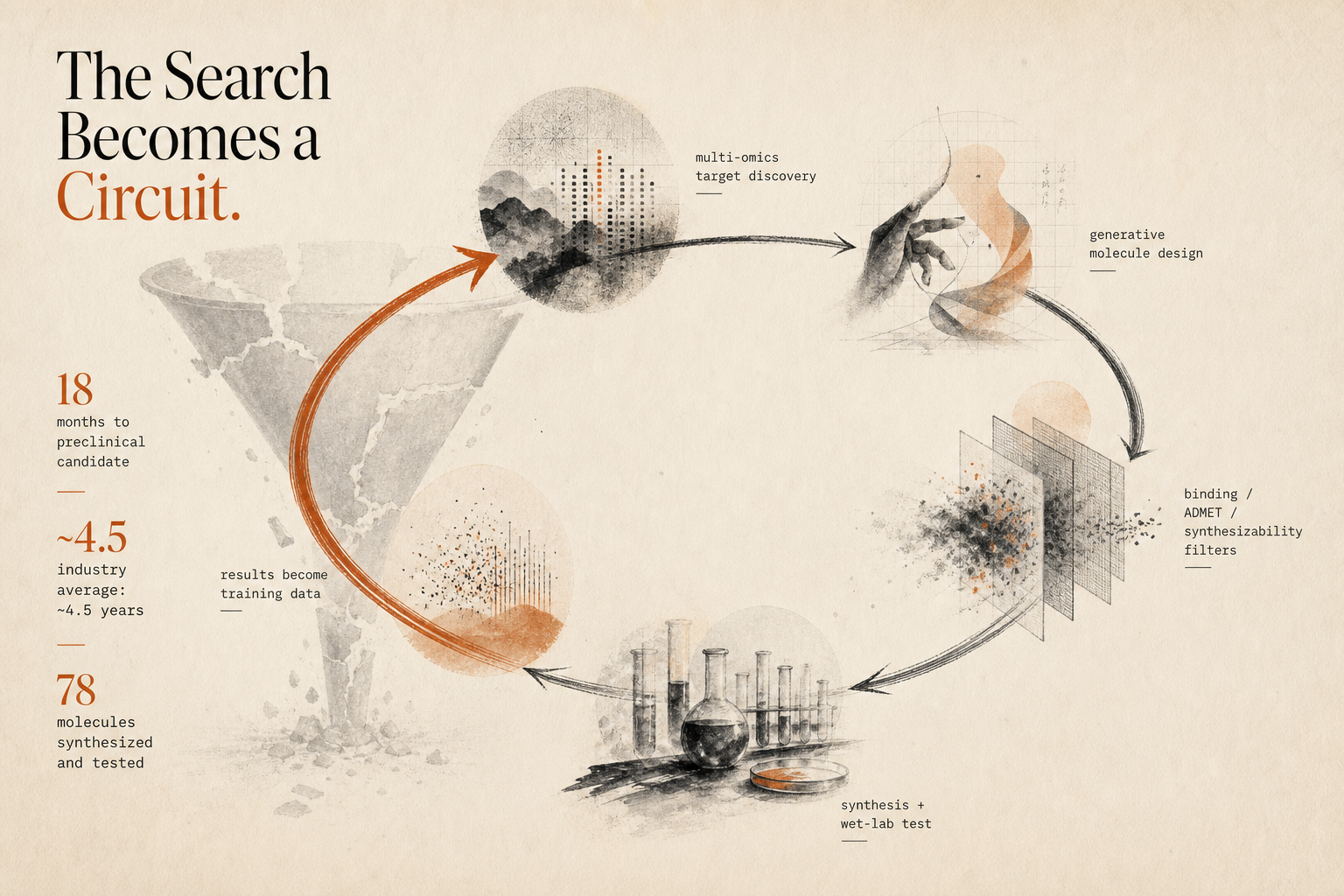
What these technical advances collectively enable is something qualitatively different from faster traditional drug discovery. They enable a closed loop. The loop works as follows. An AI system analyzes multi-omics datasets, identifying which genes or proteins are causally implicated in a disease. It generates candidate molecules designed to interact with those targets, drawing on generative models that propose structures in vast regions of chemical space that human chemists would never have visited. Predicted molecules are filtered computationally for binding affinity, ADMET properties, and synthesizability. The surviving candidates are then physically manufactured and tested in cells or animals. The results, whether positive or negative, feed back into the model. The system updates and repeats.
Traditional pharmaceutical R&D followed something like this sequence but executed it in disconnected siloes over many years, with each stage communicating poorly with the last and failures generating minimal learning for future cycles. The closed-loop model makes the connection between computational prediction and physical experiment tight, rapid, and systematic. Every experiment becomes training data. The system does not just test candidates; it learns from testing them.
The first compelling proof of concept for this model arrived in human form in June 2025, when Nature Medicine published the results of a Phase 2a clinical trial for a drug called rentosertib [11]. The molecule had been designed entirely by artificial intelligence. More precisely, both the drug's target, a kinase called TNIK, and the molecule itself had been identified and designed using Insilico Medicine's Pharma.AI platform, a suite of tools including PandaOmics for target identification and Chemistry42, which deploys more than thirty generative models running in parallel to propose and optimize chemical structures [12].
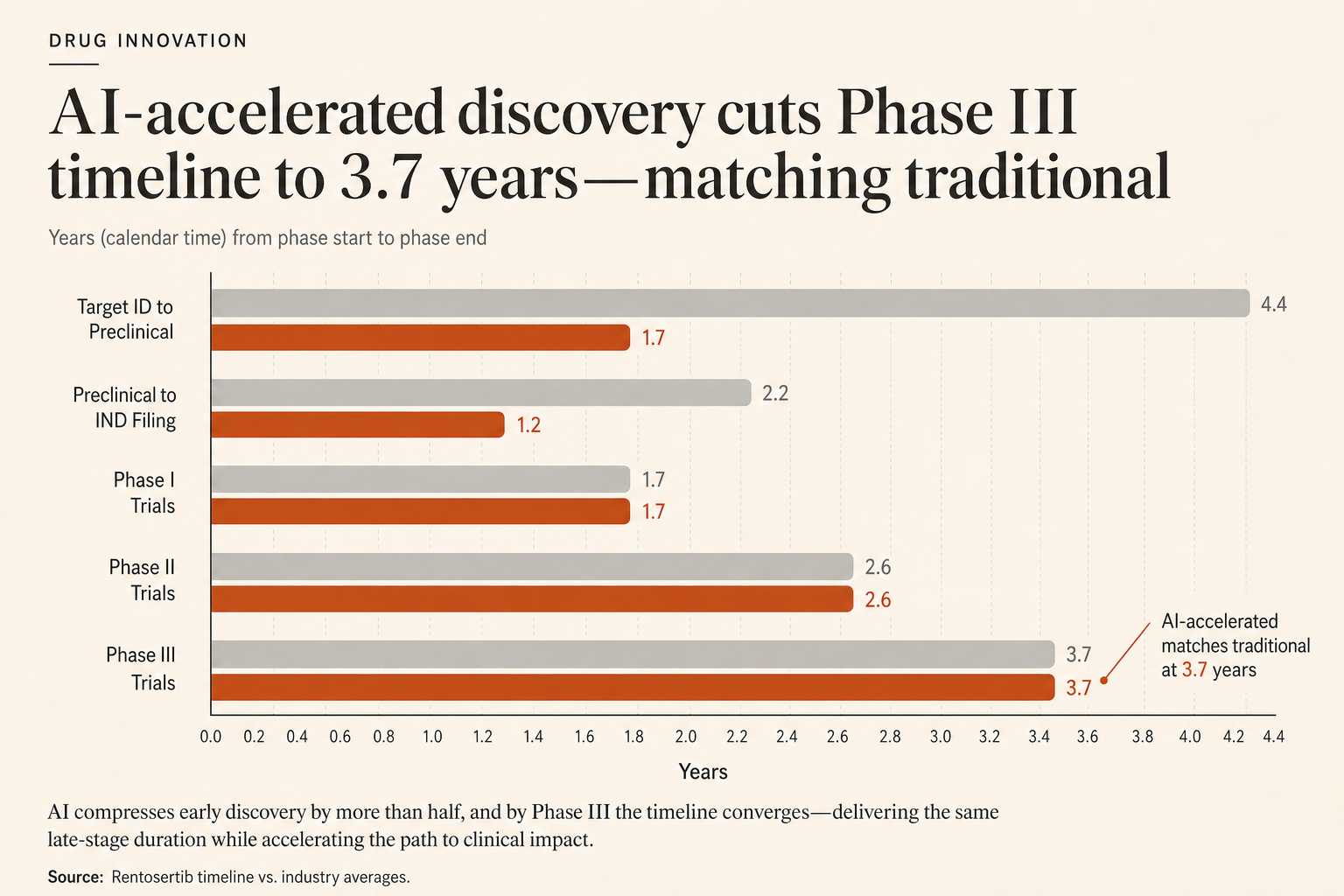
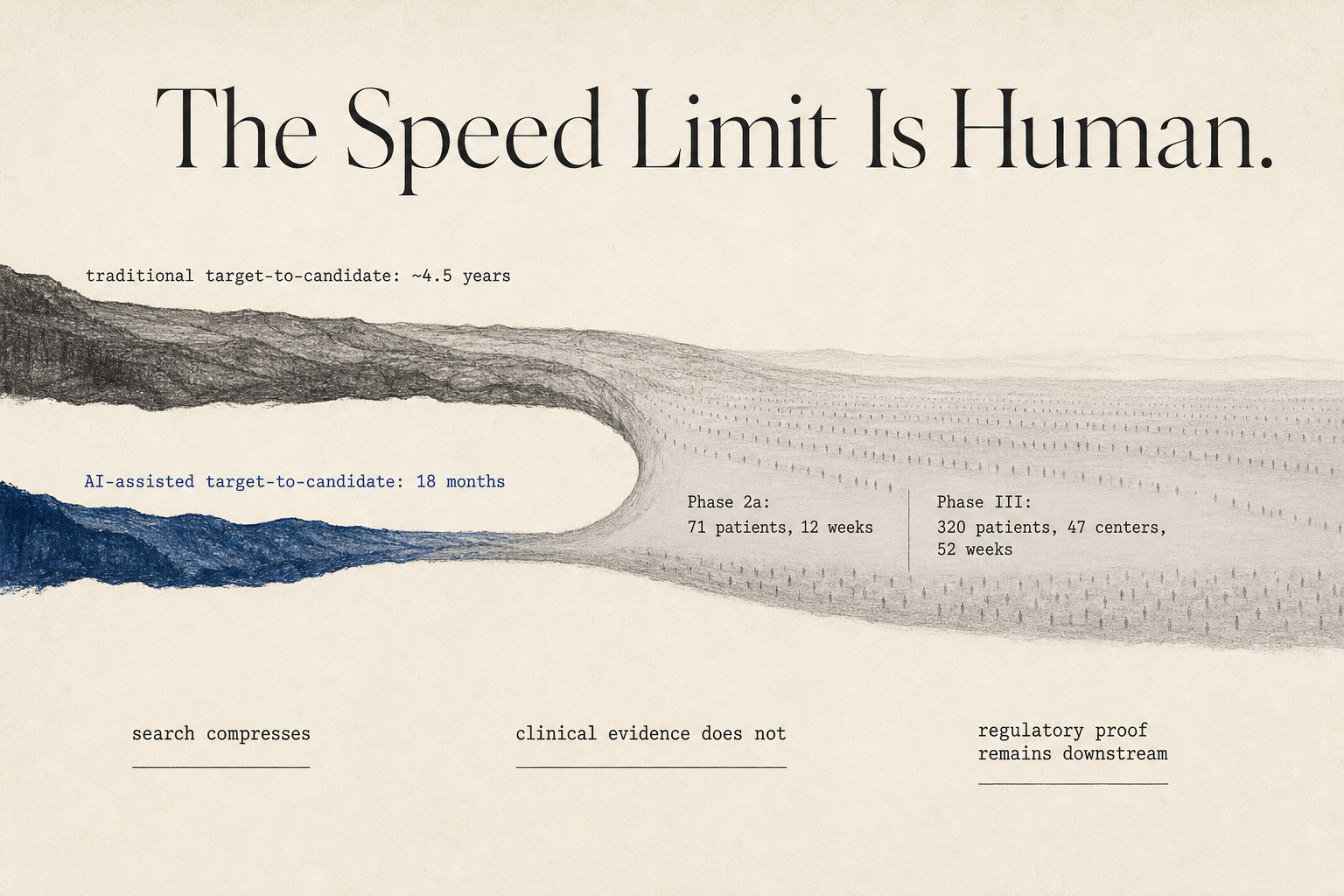
What made the rentosertib story extraordinary was the timeline. From the identification of TNIK as a target relevant to idiopathic pulmonary fibrosis to a nominated preclinical candidate took eighteen months [13]. The industry average for this phase is approximately four and a half years. Insilico's platform synthesized and tested only seventy-eight molecules during the discovery phase [13]. Conventional brute-force screening would test thousands. The company reported the initial discovery cost at around 150,000 dollars, excluding wet-lab validation [13]. Whether these figures translate linearly to all programs remains debated, but the order-of-magnitude compression in time and molecules tested is striking.
The clinical results were real enough to command attention. Seventy-one patients with idiopathic pulmonary fibrosis were randomized across four arms in a twelve-week study conducted in China. At the highest dose of sixty milligrams once daily, patients showed a mean improvement of 98.4 milliliters in forced vital capacity, compared to a mean decline of 20.3 milliliters in the placebo group [14]. In a disease where current approved treatments can only slow progression, not reverse it, improvement is a meaningful signal. The trial also revealed limits: six of eighteen patients in the high-dose group discontinued, compared to two of seventeen on placebo, primarily due to gastrointestinal disturbances and mild liver enzyme elevations [14]. Insilico's founder Alex Zhavoronkov captured the situation precisely: "Usually AI helps you significantly to accelerate preclinical R&D to go from zero to developmental candidate. Our records are 9 to 18 months. But after that, you're moving with the speed of traffic." [15] Phase III began in July 2026, enrolling 320 patients across 47 centers in China for a 52-week study [16]. The question of whether rentosertib produces clinical benefit at scale will take years to answer.
The Archetypes Emerging
The rentosertib story belongs to one emerging archetype in AI drug discovery: the end-to-end integrated platform company. Insilico Medicine, founded in 2014 by Zhavoronkov and listed on the Hong Kong Stock Exchange in December 2025, represents the vision of a single organization that owns the discovery loop from target identification through clinical prediction [17]. Eli Lilly reached this conclusion with enough conviction to sign a global R&D collaboration worth up to 2.75 billion dollars in March 2026, with 115 million dollars paid upfront [18].
A second archetype is the structure-prediction path, represented most prominently by Isomorphic Labs, the London-based Alphabet spinoff founded by Demis Hassabis in late 2021. Isomorphic's core thesis is that accurate prediction of how molecules bind to proteins is the central bottleneck in drug design, and AlphaFold technology plus its proprietary drug design engine give it an edge there. The company raised a 600 million dollar Series A in March 2025, then closed a 2.1 billion dollar Series B in May 2026, the largest financing ever in AI drug discovery, at a 3.5 billion dollar post-money valuation [19] [20]. Its pharmaceutical partnerships illustrate the commercial logic of the platform model: Eli Lilly agreed to a deal worth up to 1.7 billion dollars in performance milestones on top of a 45 million dollar upfront payment [21]. Novartis paid 37.5 million dollars upfront against up to 1.2 billion dollars in milestones [22]. Johnson and Johnson joined in January 2026. These are not payments for individual drug candidates. They are licenses to apply Isomorphic's prediction engine to targets the pharmaceutical companies care about. In January 2026, FDA cleared Isomorphic's first drug candidate, ISM8969, an oncology program, for human trials [23].
The critical distinction between Insilico and Isomorphic reveals something important about the field's structure. Insilico builds and owns its clinical pipeline, generating data that feeds back into its models. Isomorphic owns the computational engine and partners for clinical execution. One model bets that vertical integration produces the best feedback loop. The other bets that the computational layer is so valuable it can extract substantial economics without owning clinical risk.
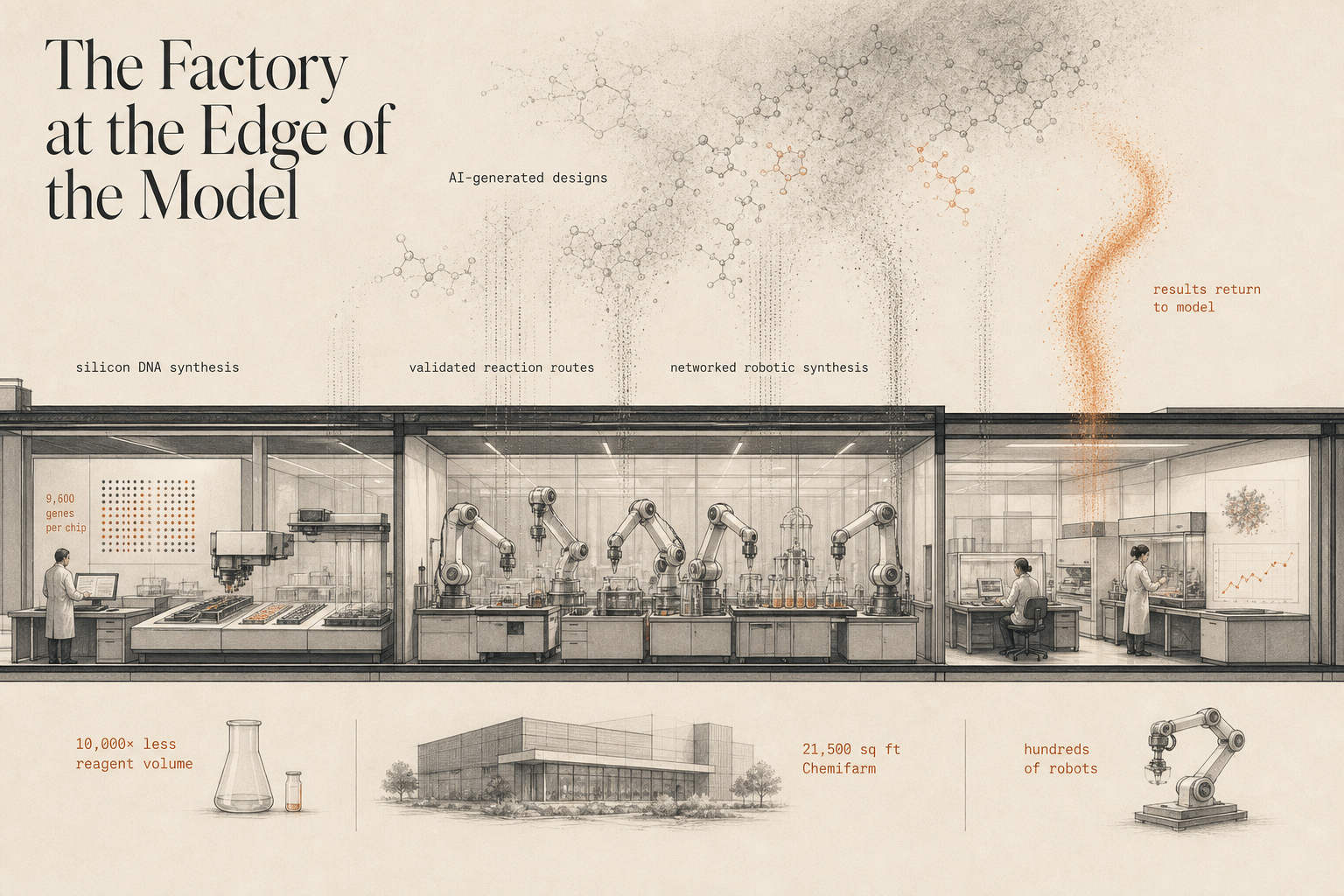
A third archetype answers a question that Insilico and Isomorphic each sidestep: what actually makes the molecules? This is the problem that Lee Cronin, the Regius Professor of Chemistry at the University of Glasgow and founder of Chemify, has made his life's work. Cronin's argument is pithy and damning. "There's all this great AI, there's all this great biology, there's all this great intent, but there's no molecules to cure the disease." [24] A digital molecule is not a drug. Someone has to synthesize it physically, and synthesis is fiendishly difficult for novel complex compounds.
Chemify, spun out of the University of Glasgow in March 2022, has built what it calls a Chemputation platform: an integrated system combining AI-driven molecular design with ASSEMBLER, a route optimization tool that restricts itself to chemical reactions validated on Chemify's own robotic systems (rather than speculating from published literature), and chi-DL, a universal chemical programming language that Cronin describes as "the Python for chemistry" [25]. The language is hardware-agnostic, meaning a synthesis procedure written in chi-DL can be executed on different robotic platforms without rewriting. The system's key patent, US Patent 12064740 B2, covers networked synthesis robots that cooperate and share learning, exponentially reducing the search required as the number of systems grows [26].
In June 2025, Chemify opened its first Chemifarm, a 21,500-square-foot fully automated chemistry facility in Glasgow's Maryhill district, housing over sixty full-time scientists and hundreds of robots [27]. A second facility is expected in 2026. The company has secured approximately 110 million pounds in total funding, including a 50 million dollar oversubscribed Series B in October 2025 led by Wing Venture Capital and Insight Partners, and 22 million pounds in public grants from Scottish Enterprise and the UK Government announced in September 2026 [28]. Cronin states that Chemify has partnerships with six of the twenty largest pharmaceutical companies, though most are not individually named publicly [29].
Chemify's position in the broader ecosystem is less about owning the AI models than about being the physical manufacturing layer that makes the models useful. As AI floods drug discovery with computational designs, the wet-lab synthesis step becomes the bottleneck. Chemify intends to be the factory that closes that gap.
The Data Infrastructure Layer
Beneath these platform companies runs an infrastructure layer that quietly enables all of them. Twist Bioscience, a NASDAQ-listed company based in South San Francisco, manufactures synthetic DNA using a proprietary silicon-based platform that miniaturizes the chemistry of DNA synthesis onto chips, achieving 9,600 genes per chip versus one per conventional 96-well plate, with a ten-thousandfold reduction in reagent volume [30]. For fiscal year 2025, ended September 30, 2025, Twist reported total revenues of 376.6 million dollars, a twenty percent increase from 313.0 million dollars the prior year, with gross margin expanding to 50.7 percent from 42.6 percent [31].
Twist's role in the AI drug discovery ecosystem is structural rather than computational. As generative AI produces floods of proposed antibody sequences and protein designs, the system's bottleneck shifts to physically making the corresponding DNA for laboratory expression and testing. Twist is the high-throughput factory enabling that step. In November 2024, Twist partnered with Absci, an AI-based drug developer, to design novel antibody therapeutics using generative AI, combining Absci's computational platform with Twist's silicon synthesis to accelerate the design-build-test cycle [32]. In May 2026, Twist announced a collaboration with LenioBio GmbH, whose cell-free protein expression platform can produce functional proteins within twenty-four hours, integrating with Twist's manufacturing to return experimental results to AI models faster [33]. The company's CEO Emily Leproust described the logic with characteristic directness: "Frankly, this collaboration is not something we can do too many of because our business model is to ramp revenue and be paid." [32]
The Focused Bet
Not every company in this space is trying to build a universal platform. Superluminal Medicines, founded in January 2022 and based in Boston, has staked its existence on deep specialization in a single protein family. G protein-coupled receptors (GPCRs) represent approximately thirty-five percent of all FDA-approved drug targets. There are roughly 850 known GPCRs, but only 138 have had their active-state structures experimentally resolved, and around seventy percent remain without approved drugs [34]. Ozempic and Wegovy target one particular GPCR; the family's potential scope is vastly larger.
What makes GPCRs technically challenging is that they are inherently dynamic. Unlike the crystalline protein structures that established structural biology can capture precisely, GPCRs exist in multiple conformational states, each coupled to a different signaling pathway inside the cell. A molecule that activates one conformational state may trigger beneficial appetite suppression. The same molecule activating a slightly different state may cause cardiovascular side effects. This "biased agonism" problem has defeated traditional structure-based drug design approaches that work from static crystal structures.
Superluminal's Hyperloop Platform addresses this by modeling protein conformational dynamics rather than static shapes. CEO Cony D'Cruz, who spent eight years as Chief Business Officer of Schrödinger before co-founding Superluminal, describes the approach as "the difference between looking at a picture and watching a movie in 3-D" [35]. The platform stitches together multiple structures to capture a protein's full range of motion, enabling the design of compounds that interact selectively with specific conformational states and, therefore, specific signaling outcomes.
Superluminal has raised a total of 213 million dollars across three rounds: a 33 million dollar seed in August 2023, a 120 million dollar Series A in September 2024, and a 60 million dollar oversubscribed Series B closed September 3, 2026 [36] [37]. Investors include RA Capital Management, Insight Partners, NVentures (NVIDIA's venture arm), and Eli Lilly. The Lilly relationship went beyond equity: in August 2025, Superluminal announced a collaboration valued at up to 1.3 billion dollars for Superluminal to apply its Hyperloop Platform to GPCR targets relevant to cardiometabolic diseases and obesity [38]. Superluminal's lead program is a biased melanocortin 4 receptor agonist targeting rare genetic forms of obesity, specifically Bardet-Biedl syndrome and hypothalamic obesity, conditions that do not respond to GLP-1 receptor drugs because the genetic defect lies downstream of the pathway that Ozempic activates [39]. A Phase I trial is expected by the end of 2026.
What Superluminal represents in the landscape is the focused model: deep vertical expertise in one target class, computational infrastructure dialed to that class's specific challenges, and early clinical validation as the proof of platform. Five programs are at lead optimization stage; only the MC4R agonist has a defined clinical timeline [36]. The bet is that specialization produces differentiation that breadth cannot replicate.
"There's all this great AI, there's all this great biology, there's all this great intent, but there's no molecules to cure the disease."
The Provocative Edge Case
The most unexpected entrant into this space is not a pharmaceutical company or an AI research lab. It is ByteDance.
The company behind TikTok began building an internal AI-for-Science team in 2021, a unit that operated quietly under Liu Kai, who came from seven years as a venture investor at IDG Capital [40]. The unit developed its own protein structure prediction models (the Protenix family, released open-source under Apache 2.0 license), generative molecular design frameworks, and a drug design platform it calls Anew Labs, which it formally spun out as an independent entity in June 2026 [41]. On September 16, 2026, Anew Labs closed a 290 million dollar Series A at a 1.5 billion dollar post-money valuation, led by HSG (formerly Sequoia China), IDG Capital, and Hillhouse Investment, with ByteDance retaining fifty-six percent ownership [42].
The question ByteDance raises is whether drug discovery is an optimization problem that looks more like recommendation algorithm engineering than traditional pharmaceutical research. TikTok's core technical accomplishment is modeling human preference across a vast, high-dimensional space of content and predicting which pieces of that space will generate engagement for which users. Drug discovery, at a mechanistic level, involves searching an even larger chemical space for molecules whose properties match a complex set of biological preferences. The abstraction is imperfect, but the computational infrastructure overlap is genuine.
Anew Labs has developed a platform suite spanning protein structure prediction (AnewFold), antibody design (AnewDesign), LLM-based scientific reasoning (AnewMind), a generative framework trained on over five million biomolecular complexes across all molecular scales (AnewOmni), molecular dynamics simulation (AnewSampling), and synthesis feasibility prediction (AnewSynth) [41]. Its Protenix-v1, released in February 2026 as a 368-million-parameter model, claimed the distinction of being the first open-source structure prediction model to match AlphaFold 3 performance across diverse benchmarks while adhering to the same training data cutoff [43]. That claim has not been independently peer-reviewed.
Anew Labs' lead drug candidate targets the IL-17 family of protein-protein interactions, a class of molecular surfaces that the pharmaceutical industry has historically classified as "undruggable" because they are large and flat, without the well-defined pockets that conventional small-molecule medicinal chemistry requires. The molecule was presented at the American Association of Immunologists meeting in Boston in April 2026, where Chris Li, Anew's head of biology, described it as targeting the simultaneous blockade of three IL-17 family dimers with a single small molecule [44]. It was preclinical at the time of presentation.
ByteDance's prior moves in healthcare give the ambition texture: the company acquired Amcare Healthcare, one of China's largest private hospital chains, for approximately 1.5 billion dollars in August 2022, giving it seven women's and children's hospitals and associated clinical infrastructure [45]. In July 2025, ByteDance invested six billion yuan to begin building an 800-bed "AI-native" hospital in Beijing [46]. The pattern is not a company dabbling in biology. It is a company with an optimization culture, vast compute infrastructure, and accumulated data engineering capability concluding that pharmaceuticals is the next domain where those capabilities apply.
The Incumbents Build the Wall
While AI-native biotechs race to establish platform credibility, the pharmaceutical incumbents are not passive. Eli Lilly has deployed a strategy of simultaneous internal build-out and aggressive external partnerships that amounts to an attempt to own both the AI layer and the clinical execution layer simultaneously.
In October 2025, Lilly announced construction of what it described as the pharmaceutical industry's most powerful AI supercomputer: an NVIDIA DGX SuperPOD system containing over 1,000 NVIDIA B300 Blackwell GPUs rated at more than nine exaflops of AI performance [47]. In January 2026, Lilly and NVIDIA announced a co-innovation laboratory in the San Francisco Bay Area committing up to one billion dollars over five years to build infrastructure, co-locate Lilly's biological scientists with NVIDIA's AI engineers, and develop a "continuous 24/7 learning system" connecting physical wet labs with computational dry labs [48]. The explicit goal, in CEO David Ricks's words, is to "explore vast biological and chemical spaces in silico before a single molecule is made" [49].
Alongside this internal build, Lilly signed sixteen AI-focused deals in 2025 alone, including seven licensing agreements worth over two billion dollars collectively [50]. The partnerships span Isomorphic Labs (up to 1.7 billion dollars), Insilico Medicine (up to 2.75 billion dollars), Superluminal (up to 1.3 billion dollars), and Chai Discovery (January 2026, terms undisclosed). Lilly also launched TuneLab in September 2025, an AI and machine learning platform that gives external biotech companies access to models trained on over a billion dollars' worth of Lilly's proprietary research data, using federated learning to protect both parties' data privacy [51].
Novo Nordisk is pursuing a parallel strategy of multi-vendor AI integration. In the same week that Anew Labs closed its funding, Novo announced on September 16, 2026, a collaboration with Anthropic to deploy Claude Science in defined R&D workflows [52]. Claude Science, launched in June 2026 as a research workbench connecting to more than sixty scientific databases with prebuilt toolkits for genomics, proteomics, structural biology, and cheminformatics, is not itself a new molecule design engine but a scientific reasoning layer [53]. It wraps existing Claude models in domain-specific infrastructure. For Novo, the interest is in compressing the cognitive work of scientific reasoning, literature synthesis, and experimental planning. The company's existing NovoScribe documentation platform, built on Claude via Amazon Bedrock, had already compressed clinical study documentation from more than ten weeks to ten minutes [54].
Novo's three major AI partnerships within six months in 2026 (OpenAI in April, AWS in August, Anthropic in September) reflect something other than commitment to any single technical solution. They reflect a company with 52 billion Danish kroner (approximately 7.3 billion dollars) in annual R&D spending [54], generating daily research costs of around 142 million kroner, that recognizes even marginal efficiency gains across that scale produce enormous absolute value. The strategy is integration rather than bet-placement.
The Power Question
Who becomes powerful when the operating system of drug discovery changes? The research suggests a more complicated answer than either the AI-triumphalist or the pharma-defensive narrative offers.
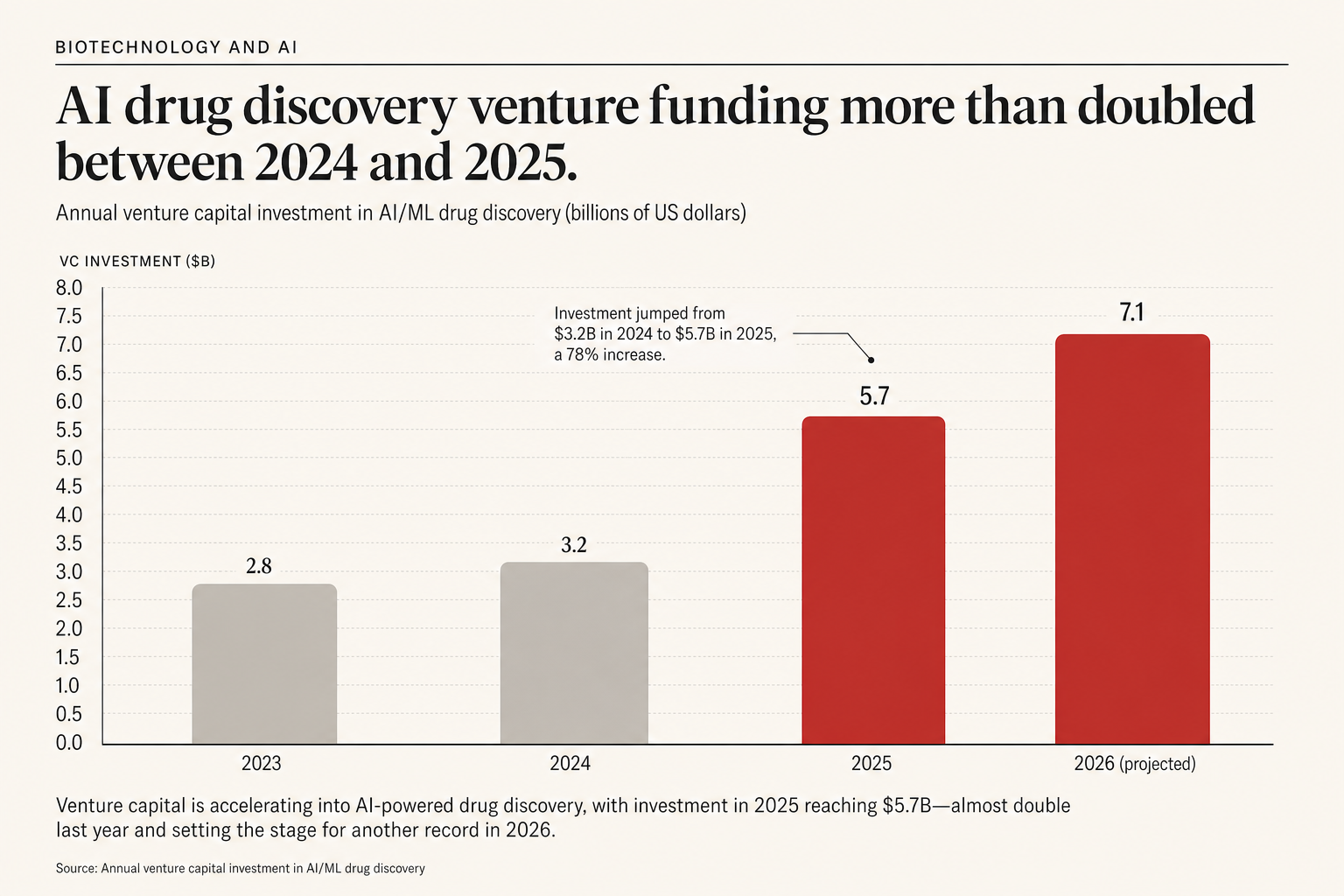
Venture capital flowing into AI drug discovery tells part of the story. Investment grew from 2.8 billion dollars in 2023 to 3.2 billion dollars in 2024, then surged to 5.7 billion dollars in 2025 [55]. Capital is concentrating rapidly at the top: in the period from August 2025 through September 2026, the three largest deals captured nearly eighty percent of disclosed capital, with Isomorphic Labs' 2.1 billion dollar round alone representing over half [56]. Over 173 AI-discovered drug programs are now in clinical development globally [55].
But the concentration of AI-native capital obscures a structural dependency. None of the AI drug discovery companies have brought a drug to market. No molecule designed primarily through AI-driven processes has received full FDA approval as of September 2026 [55]. Insilico's rentosertib is the furthest along, in Phase III. Isomorphic's ISM8969 cleared FDA for human trials in January 2026. Recursion, which merged with Exscientia in November 2024 for 688 million dollars in stock to combine Recursion's two-million-experiments-per-week automated phenotypic screening with Exscientia's generative molecular design [57], reports multiple programs in Phase I and Phase II stages. Yet the entire field's clinical validation amounts to promising early data in narrow patient populations. Phase II success rates for AI-designed molecules appear comparable to, not dramatically better than, conventional approaches, approximately forty percent [58]. Not worse, but not yet better.
The deeper structural point is that AI has demonstrably compressed the pre-clinical phase. Rentosertib is proof. A molecule that traditionally took four and a half years from target identification to preclinical nomination took eighteen months via generative AI [13]. But the biological and regulatory constraints governing clinical development remain entirely unchanged. A twelve-week Phase 2a trial still takes twelve weeks. A 320-patient Phase III trial still requires enrolling and following 320 patients. The FDA still requires years of safety data before approval. What AI accelerates is the search. It does not yet accelerate the test.
This creates a clear picture of where power currently sits and where it might shift. Compute companies, particularly NVIDIA, occupy the infrastructure layer on which all of this runs, a position that generates revenue regardless of which drug company wins any given indication. NVIDIA's partnerships now span Lilly, Novo Nordisk, Illumina, IQVIA, Mayo Clinic, the Arc Institute, and Thermo Fisher [59]. This is not pharmaceutical strategy. It is infrastructure strategy.
AI labs occupying the discovery layer (Isomorphic, Insilico, Recursion-Exscientia, Superluminal, and others) are accumulating both capital and deal economics that give them substantial leverage. But their leverage depends on pharma partners for the clinical execution they cannot themselves provide. The economics of the current deals reflect this: upfront payments are meaningful but modest (45 million dollars from Lilly to Isomorphic, 37.5 million dollars from Novartis to Isomorphic [21] [22]) against potential milestones running into the billions, milestones that are paid only if drugs work in humans. The risk of clinical failure remains on the shoulders of whichever company advances the trial.
Chemify and Twist occupy a different kind of power: the physical manufacturing layer. If AI produces a thousand more molecular candidates per year than before, someone must synthesize them. The demand for automated, scalable chemistry manufacturing rises with every advance in computational design. These companies benefit from the field's growth regardless of which specific molecules succeed.
Pharmaceutical incumbents retain control of the most durable assets: regulatory relationships, clinical trial infrastructure, manufacturing scale, and decades of proprietary safety and efficacy data that AI models need for training. Lilly's TuneLab platform, which offers AI models trained on its billion-dollar proprietary dataset to external partners, is a strategic move that turns data assets into a platform. The company is not merely buying access to AI. It is positioning its historical research investment as a source of algorithmic advantage.
ByteDance's Anew Labs represents the scenario that keeps traditional pharmaceutical strategists most alert: a company with world-class AI infrastructure, an optimization culture built over two decades of consumer-scale engineering, and no legacy commitment to conventional pharmaceutical processes, arriving at biology as if it were a new domain where the rules have not yet been fixed. Whether this proves to be an insight or an illusion depends on what happens when Anew's preclinical molecules encounter human clinical trials. The distance from a poster presented at a scientific conference to an approved medicine is measured in years, billions of dollars, and the humbling complexity of human biology. ByteDance's advantages are real. So are its inexperience in clinical operations and its complete absence from the regulatory relationships that define pharmaceutical development.
What Has Actually Changed
The operating system metaphor the field has reached for is instructive, if incomplete. A new operating system does not change the hardware it runs on. Human biology is the hardware. Regulatory process is the hardware. Clinical trial design, patient recruitment, and the statistical evidence required to demonstrate that a drug works and is safe remain as demanding as they have ever been.
What has changed is the nature and economics of the search. Traditional drug discovery searched chemical space with something close to randomness, relying on human intuition and brute-force screening to generate candidate molecules. AI-driven discovery changes the prior probability of finding something promising. Instead of testing thousands of candidates in hopes that one works, a well-designed AI platform proposes candidates that are already constrained to high-probability regions of chemical space, filtered computationally for binding affinity, ADMET properties, and synthesizability before any physical laboratory work begins. The number of molecules synthesized and tested drops dramatically. The cost and time of the pre-clinical phase compresses. The quality of the search improves.
Whether this translates into better drugs is still an open question, and a genuinely important one. The failure of most drugs in clinical trials is not primarily a failure of molecular design. It is a failure of biological understanding: the target turned out not to be as important in human disease as it seemed in model systems, or the molecule reached its target but produced effects elsewhere in the body that outweighed the benefit, or the patient population was more heterogeneous than the preclinical models suggested. AI that produces better-targeted molecules more efficiently does not directly solve these problems. It might solve them indirectly, if better computational models of human biology eventually allow prediction of clinical outcomes before trials begin. That prospect is what excites the field's most ambitious practitioners and remains its most contested open question.
The companies and institutions investing in this transformation are, in aggregate, betting that the answer is yes: that a closed loop connecting computational prediction to physical experiment to clinical data, running faster and more efficiently than traditional methods, will eventually produce not just more candidates but better ones. The 5.7 billion dollars invested in AI drug discovery in 2025 [55] and the partnerships worth tens of billions in potential milestone payments are that bet's expression in commercial terms.
The earliest returns are not yet legible in FDA approvals. They are legible in Nature Medicine papers and conference posters and preclinical candidate nominations that took eighteen months instead of four and a half years. The industry has proven that the closed loop can work in the laboratory. Whether it works in the clinic is the question the next decade will answer.
- Traditional pharmaceutical R&D followed something like this sequence but executed it in disconnected siloes over many years, with each stage communicating poorly with the last and failures generating minimal learning for future cycles.
- The system does not just test candidates; it learns from testing them.
- The industry has proven that the closed loop can work in the laboratory.
Get the next issue in your inbox.
Free, weekly. One company or market, taken completely apart — every figure sourced and verified with Valyu DeepResearch.
Issue queued.
Your next cited briefing is on its way to .